
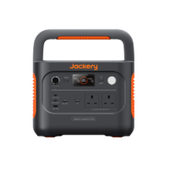

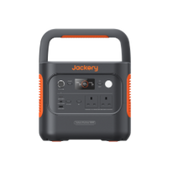

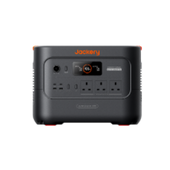

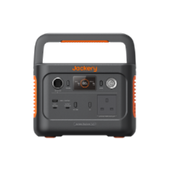


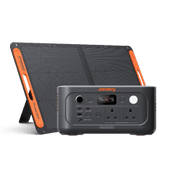
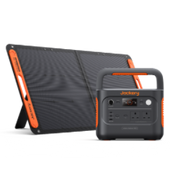
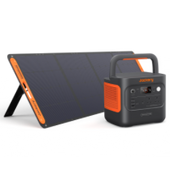
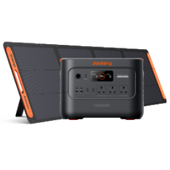
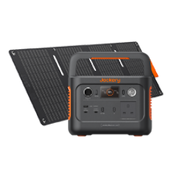






















A Jackery can run an air fryer, provided the appliance’s rated wattage does not exceed the power station’s continuous AC output. The compact Jackery Explorer 1000 v2, with a 1,500W output and 1,070Wh capacity, suits many mini and lower-wattage single-drawer air fryers. The Explorer 2000 v2 increases this to 2,200W and 2,042Wh, covering most standard models, while the Explorer 3000 v2 offers 3,600W and 3,072Wh for larger or dual-drawer appliances.
For household solar storage and backup power, the expandable Jackery SolarVault 3 Pro Max provides up to 2,500W off-grid output and starts with 2.52kWh of capacity. These options combine pure sine-wave AC power, LFP batteries and several capacity levels, allowing buyers to match output and runtime to their cooking needs. This guide compares compatibility, air fryer power consumption and estimated cooking time.
|
Key Takeaways: |
|
Can a Jackery Run an Air Fryer? The Short Answer
Yes, several Jackery Portable Power Stations can run an air fryer, provided the appliance’s rated wattage remains within the unit’s continuous AC output. Battery capacity affects cooking time, but it does not determine whether the appliance is compatible.
The Explorer 1000 v2 provides 1,500W of continuous output, making it suitable for air fryers rated up to 1,500W. However, using an appliance at that limit leaves no margin for additional equipment. The Explorer 2000 v2 supplies 2,200W, covering most single-drawer air fryers and dual-drawer models that do not exceed this rating. With a 3,600W output, the Explorer 3000 v2 can power virtually all standard UK countertop air fryers, including high-powered dual-zone appliances.
Compatibility with the SolarVault 3 Pro Max requires closer assessment. Its ability to supply an air fryer depends on the selected operating mode, configured output, other household loads and whether grid bypass is available.
Output is only half the calculation. A Jackery may start an air fryer successfully but provide limited cooking cycles if its remaining battery energy is low or other appliances are connected.
Air Fryer Power Consumption: Watts, Watt-Hours and Actual Energy Use
Understanding air fryer power consumption requires separating power from energy. Watts (W) measure the instantaneous power required while the appliance is operating. Watt-hours (Wh) measure the energy consumed over time, while kilowatt-hours (kWh) are the units recorded by a UK electricity meter and used on household bills. One kilowatt-hour equals 1,000Wh.
Air-fryer size can provide a rough indication of wattage, but capacity alone does not determine electrical demand.
|
Air fryer category |
Typical capacity |
Indicative rated power |
Common use |
|
Mini |
1.5–2.5 litres |
800–1,200W |
Snacks and one-person meals |
|
Compact single-drawer |
3–5 litres |
1,200–1,500W |
One or two people |
|
Large single-drawer |
5–7 litres |
1,500–2,000W |
Small families |
|
Dual-drawer |
7–10 litres |
2,000–2,600W |
Two foods or family meals |
|
Air-fryer oven or multicooker |
Varies |
1,700–2,800W |
Baking, roasting and larger meals |
These are broad ranges rather than guaranteed limits. Check the appliance’s rating plate, manual or manufacturer specification before connecting it to a power station. Current UK models can exceed the frequently quoted 1,500–1,700W range, with some large dual-basket appliances rated at approximately 2,470–2,750W.
Rated wattage represents the demand that the power source must be capable of supplying. Actual energy use may be lower because the heating element often cycles after the cooking chamber reaches its target temperature. However, compatibility must still be assessed against the maximum rated input.
Use this calculation:
Energy used (kWh) = Power (kW) × cooking time (hours)
For example, a 1,500W air fryer operating continuously for 20 minutes would consume up to:
- 1.5kW × 0.333 hours = 0.5kWh
Thermostat cycling may reduce the measured total, but it should not be assumed when selecting a compatible Jackery.

How to Check Whether a Jackery and Air Fryer Are Compatible
Use the following four-part test before connecting an air fryer to a Jackery.
Find the air fryer’s rated wattage
Check the rating plate, user manual or manufacturer’s product page. Use the maximum input wattage rather than relying on basket capacity or an estimated average. A large dual-drawer model may require considerably more power than a compact single-drawer appliance.
Compare it with the continuous AC output
Apply this basic rule:
Air-fryer wattage ≤ Jackery continuous AC output
A sensible margin is preferable, particularly if the air fryer’s rating is close to the power station’s limit. Do not choose a unit based on surge output alone. Surge capacity is designed for brief peaks from certain appliances, whereas an air fryer’s heating element creates a sustained load. Continuous AC output is therefore the relevant specification.
Include other appliances
Add together the rated wattage of equipment that could operate simultaneously. For example, a 1,500W air fryer and a 100W fridge create a potential combined demand of 1,600W. This would exceed the Explorer 1000 v2’s 1,500W continuous output, even though the air fryer alone appears compatible.
Estimate the required runtime
Use:
Estimated runtime (hours) = [Battery capacity (Wh) × inverter efficiency] ÷ average appliance draw (W)
An illustrative usable-energy allowance of 80–90% accounts for inverter losses and system consumption. A 1,070Wh battery using an 85% allowance provides approximately 910Wh of usable AC energy.
Actual runtime can differ because of ambient temperature, battery condition, cooking programme, thermostat cycling and other connected loads. Treat the result as a planning estimate rather than a guaranteed cooking time.
Which Jackery Can Run Which Type of Air Fryer?
The correct choice depends on two specifications: continuous AC output determines which air fryer can operate, while battery capacity influences how many cooking sessions are available. The current published ratings for the three portable models are 1,500W, 2,200W and 3,600W respectively. The SolarVault 3 Pro Max requires a separate assessment because its output changes according to operating mode and system configuration.
|
Jackery product |
Battery capacity |
Relevant output |
Air-fryer compatibility at a glance |
|
Explorer 1000 v2 |
1,070Wh |
1,500W continuous |
Compact and lower-wattage single-drawer air fryers |
|
Explorer 2000 v2 |
2,042Wh |
2,200W continuous |
Most single-drawer and many dual-drawer models |
|
Explorer 3000 v2 |
3,072Wh |
3,600W continuous |
Most UK countertop air fryers, including high-powered dual models |
|
SolarVault 3 Pro Max |
Modular 2.52–15.12kWh per tower |
Up to 2,500W backup/off-grid; up to 3,680W bypass where applicable |
Depends on appliance wattage, configuration and operating mode |
Explorer 1000 v2: Best for Compact, Lower-Wattage Air Fryers
The Explorer 1000 v2 combines a 1,070Wh battery with 1,500W of continuous AC output. It is therefore suited to mini and compact air fryers drawing approximately 800–1,400W. These commonly include small 1.5–2.5-litre models and some single-drawer appliances intended for one or two people.

A 1,500W air fryer reaches the power station’s stated output ceiling. Although it meets the rating on paper, it leaves no allowance for another AC load. Connecting a fridge, coffee machine or other device at the same time could take the combined demand above the limit. Choosing a lower-wattage fryer provides more headroom.
A 1,700W single-drawer appliance is not compatible based on continuous output, and neither are typical high-powered dual-drawer models. The 1,070Wh battery can hold enough energy for a short cooking cycle, so capacity is not usually the first restriction. The 1,500W inverter ceiling is.
This model is most relevant for one- or two-person meals, camping and occasional backup cooking where the appliance wattage has been verified in advance.
Explorer 2000 v2: Best for Most Standard Air Fryers
With 2,042Wh of capacity and 2,200W continuous output, the Explorer 2000 v2 covers a wider part of the UK air-fryer market. It can run common 1,500–1,800W single-drawer models, including many family-sized appliances. It can also support dual-drawer air fryers whose total rated input does not exceed 2,200W.

Compatibility should not be assumed for extra-large models rated at 2,400–2,750W. These exceed the continuous output even if the cooking time is short. Using only one drawer does not necessarily halve maximum electrical demand: control systems and heating arrangements vary between products. Check the manufacturer’s specification for single-zone operation rather than estimating it from the number of baskets.
The larger battery permits more cooking cycles than the Explorer 1000 v2 under comparable conditions. That can make it suitable for family camping, outdoor cooking, motorhome use where the equipment is safely positioned, and temporary household backup. Other connected loads must still be included when comparing total demand with the 2,200W ceiling.
Explorer 3000 v2: Best for High-Powered and Dual Air Fryers
The Explorer 3000 v2 provides 3,072Wh of capacity and 3,600W continuous pure sine-wave output. This is sufficient for compact and standard air fryers, as well as most dual-drawer, extra-large and countertop air-fryer ovens sold in the UK.

Models drawing approximately 2,400–2,750W remain below its output limit, leaving more electrical headroom than the smaller power stations. The 3,072Wh battery also supports more repeated meals, although the final number depends on cooking duration, thermostat cycling and other loads.
A small device may operate alongside the air fryer if their combined demand remains below 3,600W. For example, a 2,500W air fryer and a 60W portable fridge create a much lower combined load than a 2,500W fryer paired with a 2,000W kettle. Avoid operating two major heating appliances together unless their total rated demand has been calculated.
This model suits longer off-grid stays, larger households, events and more substantial power-cut preparation. Its higher output does not remove the need to check the exact air-fryer rating or monitor remaining battery energy.
SolarVault 3 Pro Max: Air-Fryer Use as Part of a Home Energy System
The SolarVault 3 Pro Max is a fixed home energy-storage system requiring professional installation, rather than a portable kitchen power station. Each tower starts at 2.52kWh and can expand to 15.12kWh, but adding battery modules extends runtime without increasing the relevant output ceiling.
|
Operating condition |
Relevant output |
What it means for an air fryer |
|
Normal grid-connected operation |
Default 800W; configurable up to 2,500W subject to installation and permissions |
Grid supply may cover demand beyond battery or solar contribution |
|
Grid bypass |
Up to 3,680W where applicable |
Higher loads may pass through while the grid is available; this is not battery-only capability |
|
Backup or off-grid operation |
Up to 2,500W |
Air fryer and all other protected loads must share this limit |
|
Expanded battery configuration |
2.52–15.12kWh per tower |
More stored energy increases runtime but does not raise the 2,500W backup limit |
An air fryer rated at up to 2,500W may be supported during backup, subject to the installed configuration and total load on protected circuits. A model above 2,500W should not automatically be treated as compatible when the grid is unavailable.

Refrigeration, lighting, broadband equipment and other backed-up circuits reduce the output available for cooking. Grid-bypass capability must not be confused with battery-only performance: the system behaves differently when mains electricity is present. Circuit selection, configured output and backup arrangements should therefore be confirmed with the installer before an air fryer is included in a household outage plan.
How Long Will a Jackery Run an Air Fryer?
Runtime should be treated as an estimate rather than a fixed promise. Two useful approaches are theoretical continuous runtime and energy per cooking cycle.
Theoretical Continuous Runtime
The following estimates apply an illustrative 85% usable-energy factor for inverter losses and the power station’s own consumption:
Estimated runtime = [Battery capacity (Wh) × 0.85] ÷ appliance wattage
|
Jackery |
At 1,000W |
At 1,500W |
At 1,800W |
At 2,400W |
|
Explorer 1000 v2 |
Approx. 55 min |
Approx. 36 min* |
Not compatible |
Not compatible |
|
Explorer 2000 v2 |
Approx. 104 min |
Approx. 69 min |
Approx. 58 min |
Above rated output |
|
Explorer 3000 v2 |
Approx. 157 min |
Approx. 104 min |
Approx. 87 min |
Approx. 65 min |
*At the Explorer 1000 v2’s maximum continuous output; a lower-wattage fryer provides a more comfortable margin.
These figures assume a fully charged battery, no other connected devices and a constant load. For example, the Explorer 2000 v2 calculation at 1,800W is:
- (2,042Wh × 0.85) ÷ 1,800W = 0.964 hours, or approximately 58 minutes
Continuous runtime is useful for comparing models, but most meals require only a fraction of an hour.
Energy per Cooking Cycle
The energy needed for one cooking cycle can be calculated as:
Energy used (Wh) = appliance wattage × cooking time in hours
|
Air-fryer load and cooking time |
Maximum appliance-side energy use |
|
1,000W for 20 minutes |
Approx. 333Wh |
|
1,500W for 20 minutes |
Approx. 500Wh |
|
1,800W for 25 minutes |
Approx. 750Wh |
|
2,400W for 30 minutes |
Approx. 1,200Wh |
These examples allow readers to estimate meals more realistically. At an illustrative 85% usable capacity, the Explorer 2000 v2 provides about 1,736Wh of AC energy. It could therefore supply roughly three complete 500Wh cycles, with some energy remaining, or about two 750Wh cycles. The Explorer 3000 v2 provides approximately 2,611Wh on the same basis, enough for about two 1,200Wh cycles.
Actual air fryer power consumption may be lower because the heating element cycles after reaching the selected temperature. Shorter cooking programmes and partial heating cycles can therefore increase the number of meals.
However, thermostat cycling should never be used to justify connecting an air fryer whose rated wattage exceeds the Jackery’s continuous output. Battery charge level, temperature, ageing and simultaneous loads can also shorten runtime.

Real Cooking Scenarios: Which Combination Makes Sense?
The following hypothetical examples translate wattage and capacity into recognisable meals. They assume a fully charged battery and an illustrative 85% usable-energy allowance. Actual consumption may be lower when the heating element cycles, but the calculations use the appliance’s full rated power throughout the cooking period.
|
Cooking scenario |
Appliance and time |
Maximum energy calculation |
Compatible option |
Approximate usable energy remaining |
Important limitation |
|
Two portions of chips |
1,200W compact fryer for 20 minutes |
1,200W × 0.333 hours = 400Wh |
Explorer 1000 v2 |
About 510Wh, or 56% of its estimated usable AC energy |
Little room for another substantial appliance while cooking |
|
Family chicken dinner |
1,700W single-drawer fryer for 30 minutes |
1,700W × 0.5 hours = 850Wh |
Explorer 2000 v2 |
About 886Wh, or 51% |
Cooking time may need extending for a heavily loaded basket |
|
Dual-drawer main and side |
2,400W fryer for 30 minutes |
2,400W × 0.5 hours = 1,200Wh |
Explorer 3000 v2 |
About 1,411Wh, or 54% |
Kettles, heaters and other high-load devices should not run simultaneously |
|
Power-cut dinner at home |
1,500W fryer for 25 minutes |
1,500W × 0.417 hours = 625Wh |
SolarVault 3 Pro Max-backed circuit |
Depends on installed capacity and other protected loads |
Backup output is shared across the selected household circuits |
For the first scenario, the Explorer 1000 v2 has approximately 910Wh of illustrative usable AC energy. After a maximum 400Wh cooking cycle, around 510Wh remains for lighting, charging or another meal.
The Explorer 2000 v2 provides about 1,736Wh on the same basis. A 30-minute chicken programme drawing continuously at 1,700W would use up to 850Wh, leaving roughly half the usable reserve.
A 2,400W dual-drawer fryer requires the Explorer 3000 v2 because it exceeds the smaller models’ continuous outputs. Its estimated 2,611Wh of usable AC energy leaves about 1,411Wh after the meal.
For a SolarVault 3 Pro Max-backed dinner, refrigerator, broadband and lighting demand must be added to the air fryer’s load. The installer should confirm that the kitchen socket is protected and that the combined demand stays within the configured backup limit.
Can Solar Panels Keep an Air Fryer Running?
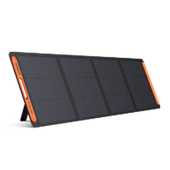
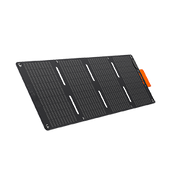
A solar panel does not normally power an air fryer directly. Portable panels feed DC electricity into the Jackery’s charging system, while the battery and inverter provide the stable 230V AC supply required by a UK air fryer. Solar generation may reduce the battery’s net discharge, but it does not change the power station’s continuous output limit.
An air fryer can consume energy much faster than portable panels replace it. For example, a 1,500W air fryer operating for 20 minutes would use up to:
1,500W × 0.333 hours = approximately 500Wh
A 200W panel producing its full rated output would theoretically need 2.5 hours to generate 500Wh:
500Wh ÷ 200W = 2.5 hours
Actual replacement time would be longer after charging losses and periods below rated panel output. UK cloud cover, season, solar angle, shading and panel temperature can all reduce generation. A clear summer period around midday may extend available cooking energy, but this contribution should not be treated as guaranteed.
Starting with a fully charged Explorer is therefore more dependable than expecting real-time solar input to cover a sustained 1,500–2,500W cooking load. Portable panels are better viewed as a way to replenish part of the energy before or after cooking.
The SolarVault 3 Pro Max operates differently because it forms part of a professionally installed home energy system. Its larger PV input and modular battery can combine household solar generation, storage and grid supply, depending on configuration. By contrast, an Explorer uses compatible portable panels and remains limited by its own solar-input rating, battery state and inverter output.
Air Fryer Power Consumption and UK Running Costs
The cost of using an air fryer depends on its measured energy consumption and the household’s electricity tariff:
Cost = energy used (kWh) × electricity unit rate
The table below uses R as an editable electricity rate in pence per kWh. Replace R with the unit rate shown on the household’s tariff; the standing charge is excluded because it is payable regardless of whether the air fryer is used.
|
Air fryer rating |
15-minute session |
20-minute session |
30-minute session |
|
1,000W |
0.250kWh; cost = 0.250 × R |
0.333kWh; cost = 0.333 × R |
0.500kWh; cost = 0.500 × R |
|
1,500W |
0.375kWh; cost = 0.375 × R |
0.500kWh; cost = 0.500 × R |
0.750kWh; cost = 0.750 × R |
|
2,000W |
0.500kWh; cost = 0.500 × R |
0.667kWh; cost = 0.667 × R |
1.000kWh; cost = 1.000 × R |
|
2,500W |
0.625kWh; cost = 0.625 × R |
0.833kWh; cost = 0.833 × R |
1.250kWh; cost = 1.250 × R |
For example, at an illustrative rate of 26p/kWh, a 1,500W air fryer running continuously for 20 minutes would cost up to:
0.500kWh × 26p = 13p
Thermostat cycling may reduce the measured total. A plug-in energy monitor can provide a more accurate figure for a particular recipe.
Charging a Jackery from the grid does not make cooking electricity free. Conversion losses mean that the grid energy required to replenish the battery can exceed the energy delivered to the appliance. Solar charging may reduce imported electricity, but savings depend on available generation and the value of any export payment forgone by storing that energy.
An air fryer can consume less energy than a full-size oven when preparing smaller portions because it heats a smaller chamber and may cook faster. However, a large dual-zone model is not automatically cheaper. Running both drawers for a small meal may use more electricity than choosing one drawer or a suitably sized single-basket appliance.
Safety When Running an Air Fryer from a Portable Power Station
Place both devices on stable, level and dry surfaces where they cannot be knocked over. The air fryer should sit on a heat-resistant surface with the clearance specified in its manual. Keep it away from tent walls, curtains, bedding, paper, packaging and other combustible materials.
Maintain unobstructed ventilation around the air fryer and power station. Portable power stations do not produce exhaust fumes, but this does not make every enclosed location suitable for cooking. An air fryer releases substantial heat and hot air, while the power station also needs airflow. Do not operate either device in a cramped vehicle unless there is adequate space, ventilation and a safe cooking surface.
Connect the air fryer directly to a suitable AC outlet on the power station where possible. Electrical Safety First advises against plugging air fryers into extension leads because of the risk of overheating. Never use damaged plugs, cables or adapters, daisy-chain extension leads, or overload a multi-socket strip. Keep cables away from the fryer’s hot surfaces and check for unusual heat, smells, buzzing or visible damage.
Protect the power station from rain, condensation, mud, cooking oil and grease. A shelter must not block its cooling vents. Stop using either device if it becomes wet, damaged or unusually hot.
A portable power station must never be connected directly to household wiring or used to energise a home circuit through a wall socket. Fixed backup arrangements require correctly designed changeover equipment and professional installation.
At campsites, caravan parks and events, follow the operator’s rules on cooking locations, appliance wattage and portable batteries. Remain nearby while cooking, disconnect equipment after use and allow the air fryer to cool before cleaning or storage.
FAQs
The following are the frequently asked questions about Jackery running an air fryer:
Can a Jackery Explorer 1000 v2 run an air fryer?
Yes, if the air fryer’s rated input does not exceed the Explorer 1000 v2’s 1,500W continuous output. It is better suited to mini and compact models rated around 800–1,400W. A 1,500W air fryer leaves no output allowance for another AC appliance.
Can a Jackery Explorer 2000 v2 run a dual air fryer?
Yes, but only when the dual air fryer’s total rated input is no more than 2,200W. Some dual-drawer models fall within this limit, while larger units rated around 2,400–2,750W do not. Check the complete appliance rating rather than assuming that one drawer uses half the stated wattage.
Can the Explorer 3000 v2 run a Ninja air fryer?
- The Explorer 3000 v2 can run a Ninja air fryer whose rated input remains within its 3,600W continuous output. This covers most UK Ninja countertop models, including many high-powered dual-zone appliances. Confirm the exact wattage because specifications vary between Ninja models.
How many watts does an air fryer use?
Air fryers commonly use around 800–2,600W, although some multifunction or extra-large models can reach approximately 2,800W. Mini air fryers tend to use the least power, while large dual-drawer and air-fryer oven models generally require more.
How much battery does 20 minutes of air frying use?
A 1,000W air fryer uses up to approximately 333Wh in 20 minutes, while a 1,500W model uses about 500Wh. A 2,000W unit would use around 667Wh, and a 2,500W model approximately 833Wh. Battery depletion may be slightly higher because of inverter and system losses.
Can I use an air fryer while charging a Jackery?
Potentially, if the specific Jackery supports pass-through operation and all input, output and temperature limits are observed. The air fryer’s demand may exceed incoming charging power, so the battery can continue discharging. High sustained loads also generate heat, making ventilation and the model’s manual important.
Can solar panels power an air fryer directly?
Normally, no. Solar panels charge the Jackery battery, while its inverter supplies stable 230V AC power to the air fryer. Solar input may slow battery depletion, but portable panels rarely replace energy as quickly as a 1,500–2,500W air fryer consumes it.
Will an air fryer damage a portable power station?
A compatible air fryer should not damage a correctly operated power station. Problems can arise if the appliance exceeds the continuous output, ventilation is blocked, equipment becomes wet or cables are unsuitable. Overload protection may shut the power station down, but it should not be relied upon as a substitute for correct sizing.
Final Thoughts
The answer to “can a Jackery run an air fryer?” depends first on whether the appliance fits within the Jackery’s continuous AC output. Usable battery capacity then determines how many minutes or cooking cycles are available.
The Explorer 1000 v2 suits mini and compact air fryers, while the Explorer 2000 v2 covers most standard and large single-drawer models. The Explorer 3000 v2 provides the output needed for high-wattage and many dual-drawer appliances. At home, the SolarVault 3 Pro Max can support solar-powered or backup cooking within its configured output and the combined demand of protected circuits.
Before choosing, check the air fryer’s rating plate, compare its wattage with continuous output and leave reasonable headroom. Calculate the energy needed for the expected cooking time and include every simultaneous load. Do not treat surge output as sustained capability or estimate runtime from stated battery capacity alone.


