

















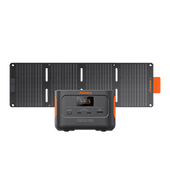







































A solar EV charger is not essential for owning an electric car, but it can reduce reliance on grid electricity when the vehicle is parked at home during daylight hours. By directing surplus solar generation to the car, UK households may lower charging costs, increase solar self-consumption and avoid some higher-priced daytime electricity.
However, output varies with cloud cover and season, so most drivers will still need grid charging or a home battery, particularly during winter and overnight.
Storage such as the Jackery SolarVault 3 Pro Max can retain surplus electricity for household appliances and, through a compatible EV chargepoint, contribute to later car charging. Its modular LFP capacity can expand from 2.52kWh to 15.12kWh per tower. Whether solar EV charging is worthwhile ultimately depends on roof generation, driving mileage, parking habits, tariffs and installation costs.
|
Key Takeaways: |
|
Solar EV Charging in the UK
A solar EV charger allows a UK household to use electricity generated by solar panels to charge an electric car. However, the term does not usually describe a standalone charger connected directly to the panels. It refers to a coordinated home-energy system that generates, measures and directs electricity according to household demand and available solar production.
A typical system includes:
- Solar PV panels that generate DC electricity
- An inverter that converts DC electricity into usable AC electricity
- The household consumer unit and electricity meter
- A solar-compatible smart EV chargepoint
- Optional battery storage and energy-management controls
- A grid connection for topping up the supply
Household appliances normally use the available solar electricity first. A meter or current transformer then detects any surplus that would otherwise be exported. The smart chargepoint can respond by starting, stopping or adjusting the car’s charging rate. The vehicle still receives AC electricity through its normal charging inlet, typically using a Type 2 connection; there is no direct electrical link between the rooftop panels and the EV battery.
A solar powered EV charger therefore does not necessarily mean off-grid charging. Solar output changes with cloud cover, roof orientation, shading, season and time of day. UK generation is generally stronger during longer summer days and lower during winter.
Most households consequently charge with a changing mixture of surplus solar and grid electricity. The solar contribution depends on when the car is at home, how much power the property is already consuming and which charging mode the owner selects.

How Does a Solar EV Charger Work?
A solar EV charger continuously compares solar generation with household electricity demand. Rather than charging at one fixed rate, a properly integrated chargepoint can vary its output so that the car absorbs electricity that might otherwise be exported. The exact behaviour depends on the selected charging mode, available surplus and technical limits of both the charger and vehicle.
The Electricity Flow
The process begins when solar PV panels generate direct-current electricity. A solar inverter converts this DC electricity into alternating current that can be used by the property and EV chargepoint.
Electricity then moves through the system:
Solar panels generate DC electricity.
The inverter converts it into usable AC electricity.
Household appliances consume the available solar power first.
A meter or current transformer measures electricity flowing to or from the grid.
The smart chargepoint raises or lowers EV charging to follow the measured surplus.
The grid supplies any shortfall if the selected mode permits grid import.
For example, if the panels produce 4kW while the home uses 1kW, approximately 3kW may be available for the car before conversion losses and system controls are considered. If a kettle or oven is switched on, the charger can reduce its output to prevent unnecessary grid import. Solar charging also has a minimum operating threshold.
Many EVs require approximately 6A before AC charging can begin, equivalent to around 1.4kW on a single-phase UK supply. If surplus production falls below the required level, solar-only charging may pause.
Solar-Only, Solar-Plus-Grid and Scheduled Charging Modes
|
Charging mode |
How it works |
Best suited to |
|
Solar-surplus mode |
Charges only when measured export exceeds the charger’s minimum operating level |
Cars parked at home during daylight |
|
Eco or blended mode |
Combines available solar generation with a limited amount of grid electricity |
Drivers needing more predictable charging |
|
Fast mode |
Charges at the full rate available from the chargepoint and electrical supply |
Urgent charging before a journey |
|
Scheduled mode |
Charges during a selected period, commonly a cheap overnight tariff window |
Commuters whose cars are away during the day |
An ordinary smart charger can offer app control, departure schedules and off-peak grid charging without being able to follow solar production. Genuine solar integration normally requires a compatible meter or current transformer to measure import and export, plus control software capable of adjusting the charging current.
Compatibility should therefore be checked across the charger, solar system, monitoring hardware and any home battery—not assumed from the word “smart” alone.
Can You Charge an Electric Car Using Solar Panels in the UK?
Yes, an electric car can be charged using solar panels in the UK, but the proportion supplied by solar electricity varies considerably. A suitable roof is the starting point: its usable area, direction, pitch and shading determine how much PV capacity can be installed and when the array generates most strongly. The system’s location and seasonal daylight hours also affect its annual and monthly output.
Successful solar charging depends on more than the panels. Household appliances receive electricity from the same supply, so daytime demand reduces the surplus available to the EV. Charging opportunities are generally better when the car remains at home through the middle of the day. Annual mileage, vehicle efficiency and battery capacity determine how many kilowatt-hours must be replaced, while the EV’s minimum charging current determines whether low solar output is sufficient to start or maintain a session.
The chargepoint must also be able to measure and dynamically follow surplus generation. Without this function, it may charge at a fixed rate and import electricity whenever solar output falls short.
Summer daytime charging can contain a high proportion of solar electricity because UK days are longer and PV generation is stronger. During winter, shorter days, lower sun angles and cloudy weather usually increase dependence on the grid. A solar powered EV charger should therefore not be presented as guaranteeing solar-only motoring throughout the year.
|
Household scenario |
Likely charging pattern |
Suitable approach |
|
Remote worker |
Car is available during peak daylight hours |
Use solar-surplus mode and add grid electricity only when necessary |
|
Daily commuter |
Car returns after solar production has declined |
Use a cheap overnight tariff or consider battery storage after comparing costs and losses |
|
Irregular journeys with a home battery |
Charging times and solar availability change from day to day |
Coordinate the EV, battery and household loads through defined energy priorities |
Private off-street parking makes home charging considerably simpler. Residents who park on the street should never trail a loose cable across the footway, where it could create an obstruction or trip hazard.
They may need permission from the local authority and an approved cross-pavement channel or charging-gully solution. Availability, installation standards and approval processes differ between councils, so these must be checked before purchasing a chargepoint.

What Equipment Do You Need?
Solar EV charging relies on several components working together rather than one specialist device. The panels must produce usable surplus, the monitoring equipment must detect it, and the chargepoint must adjust its output without overloading the household supply.
Solar Panels and Inverter
The PV system should be sized for the property’s existing electricity consumption as well as the additional energy required by the EV. Adding panels based only on the car’s battery capacity may overlook household demand and seasonal generation.
Check:
- Array capacity in kWp
- Realistic annual and seasonal generation
- Roof orientation, pitch and shading
- Inverter output, efficiency and monitoring capability
- Any export limitation agreed with the DNO
- Whether the inverter or a third-party meter can communicate with the charger
An inverter does not always need to control the EV charger directly. Many solar-compatible chargers instead use a current transformer or dedicated energy meter to measure import and export at the property’s grid connection. This can make integration possible across different equipment brands, subject to confirmed compatibility.
A Solar-Compatible Smart EV Chargepoint
Not every smart charger can track solar surplus. UK buyers should compare:
- Solar-surplus and blended charging modes
- Adjustable charging current
- Dynamic load balancing
- CT clamp or compatible meter integration
- Tethered or untethered connection
- Type 2 compatibility
- App, Wi-Fi, Ethernet or mobile connectivity
- Electricity-tariff scheduling
- Built-in or separately provided PEN-fault protection
- Compatibility with the electricity supplier and vehicle
- Home-battery priority controls
- Warranty length and UK technical support
Load balancing is particularly important where the EV charger, electric heating, cooker and other high-power appliances could operate simultaneously. It reduces charging power when necessary to keep total demand within the property’s electrical limit.
Private domestic and workplace chargepoints sold in Great Britain generally need to comply with the Electric Vehicles (Smart Charge Points) Regulations 2021. Required capabilities include smart operation, electricity-supplier interoperability and continued basic charging if the communications network fails. The rules contain specific exemptions and do not extend to Northern Ireland, where separate requirements should be checked. UK Government smart-chargepoint guidance
Is Home Battery Storage Necessary?
A battery is optional, not an essential component of an EV solar charger. It can retain daytime surplus for household use or later charging, but transferring energy through a stationary battery introduces conversion losses and additional battery cycling. Its usable capacity and output may also be modest compared with a large EV battery, while evening appliances compete for the same stored energy.
The Jackery SolarVault 3 Pro Max is a modular home solar-storage option that can help manage energy for household use. It is not itself an EV chargepoint. Before combining it with EV charging, the installer must verify the metering arrangement, charger controls, circuit protection, battery priorities and available output across the complete system. This prevents an assumption that expandable storage capacity automatically provides the power required for fast car charging.
How Many Solar Panels Are Needed to Charge an EV?
There is no universal panel number because two separate questions must be answered. First, can the array generate enough energy across a year to match the EV’s annual demand? Second, can it provide enough surplus power at the time the vehicle is connected? Annual energy matching does not guarantee uninterrupted daytime charging.
Estimate Annual EV Electricity Demand
A useful starting calculation is:
Annual EV charging demand = annual mileage ÷ vehicle efficiency × charging-loss allowance
Consider a car travelling 8,000 miles per year at an average efficiency of 3.5 miles/kWh:
- 8,000 ÷ 3.5 = approximately 2,286kWh delivered to the vehicle
Charging is not perfectly efficient because energy is used by cables, power electronics, battery conditioning and vehicle systems. Applying an illustrative 12% allowance gives:
- 2,286 × 1.12 = approximately 2,560kWh drawn from the household supply
This can be compared with a roof-specific annual PV forecast. For example, a 4kWp array producing an estimated 850kWh per installed kWp would generate around 3,400kWh annually. However, household appliances may consume much of that electricity before it reaches the car.
Convert the Requirement into Panel Numbers
The following table assumes 3.5 miles/kWh, a 12% charging-loss allowance and 500W panels. Each panel is assumed to generate around 425kWh annually, based on an illustrative yield of 850kWh per kWp. Actual UK output varies by location, roof direction, pitch, shading and system losses.
|
Annual mileage |
EV efficiency |
Approximate annual charging demand* |
Indicative 500W panels** |
Main consideration |
|
5,000 miles |
3.5 miles/kWh |
Around 1,600kWh |
4 panels |
May fit within an existing array’s surplus |
|
8,000 miles |
3.5 miles/kWh |
Around 2,560kWh |
7 panels |
Often requires meaningful additional PV generation |
|
12,000 miles |
3.5 miles/kWh |
Around 3,840kWh |
10 panels |
Daytime vehicle availability becomes especially important |
*Including an illustrative allowance for charging losses.
**Equivalent annual generation before household consumption, not a recommended system size.
These panel numbers should not be added automatically to the home’s existing requirement. The installer must assess domestic electricity use, available roof area and how much generation will coincide with EV charging.
Why Panel Count Does Not Determine Charging Speed
Panel wattage is measured under standard test conditions, whereas real-time output changes with sunlight, temperature and cloud cover. A system capable of matching the EV’s annual consumption may still be unable to supply a constant 7kW on a cloudy afternoon.
Available charging power is reduced by the household base load and may also be constrained by inverter output, export limits or charger settings. Seasonal variation is substantial, while clipping, cable losses, conversion losses and temporary shading further reduce usable output.
Panel sizing should therefore use an MCS-style yield forecast based on the property’s location, roof and proposed layout. Charging-time analysis should then be completed separately using realistic hourly surplus, not annual generation alone.
Solar EV Charging Times: What Should UK Drivers Expect?
Solar EV charging time depends on the amount of energy required, the vehicle’s onboard AC charger, the chargepoint rating and the average power available throughout the session. The number of panels alone cannot determine how quickly an EV will charge because their combined output changes continually.
The basic calculation is:
Charging time = energy required ÷ average charging power
For example, adding 40kWh at a constant 7kW would take approximately 5.7 hours before charging losses. The same energy supplied by an average solar surplus of 2kW would require about 20 hours of active charging, potentially spread across several days.
|
Charging source |
Approximate power |
Time to add 40kWh before losses |
|
Three-pin socket |
2.3kW |
17.4 hours |
|
Variable solar surplus |
1.4–3.6kW |
Approximately 11–29 hours |
|
Standard home chargepoint |
7kW |
5.7 hours |
|
Three-phase home charging |
Up to 11kW, vehicle and supply permitting |
3.6 hours |
These figures assume constant power and exclude losses, so actual sessions will take longer. The car may also limit the rate through its onboard AC charger. An EV that accepts a maximum of 7kW on AC will not charge at 11kW merely because a three-phase chargepoint is installed.
Solar-surplus charging is less predictable than fixed-rate grid charging. Passing clouds can reduce PV output, while a kettle, oven or heat pump can divert electricity away from the car. If the remaining surplus drops below the vehicle’s minimum charging threshold, often around 1.4kW on a single-phase supply, the session may pause. Repeated starting and stopping can be managed differently depending on the charger’s controls.
Drivers who need a defined amount of energy by a departure time can use a solar-plus-grid mode. This follows the available surplus while drawing enough grid electricity to maintain charging. Another option is to collect daytime solar when available and schedule any remaining requirement during a cheaper overnight tariff window.
A three-pin socket offers slower charging and is not the preferred long-term solution for regular high-energy use; a properly installed dedicated chargepoint provides stronger protection and control. Residential solar charging should also not be compared with public rapid or ultra-rapid charging. Those facilities use high-power DC equipment and network connections that are fundamentally different from a typical UK home installation.
Solar EV Charger Costs in the UK
The cost of a solar EV charger should be divided into the chargepoint, electrical work, solar-monitoring equipment and any property-specific upgrades. A low advertised price may cover only straightforward installations, while the final bill can rise substantially where cabling, groundworks or the consumer unit require additional work.
EV Chargepoint and Standard Installation
A typical UK home chargepoint installation often costs approximately £800–£1,200, including the charger and standard fitting. Current solar-compatible charger listings commonly start at around £800 installed, although the definition of “standard installation” varies between suppliers.
The quotation should state the included cable length, wall drilling, protective equipment, commissioning, DNO notification and solar-monitoring hardware. Longer routes, detached garages, trenching, difficult parking positions, consumer-unit alterations or supply-capacity issues can move the cost beyond the typical range.
Additional Costs to Check
|
Budget component |
What to confirm |
|
Chargepoint hardware |
Model, output, tethered or untethered design, cable and warranty |
|
Standard installation |
Included labour, cable length, testing, certification and commissioning |
|
Solar-monitoring meter or CT clamps |
Whether these are supplied with the charger or charged separately |
|
Additional cabling and trenching |
Price per metre, excavation, reinstatement and route to a garage or parking space |
|
Consumer-unit or earthing upgrades |
Need for additional protective devices, a separate enclosure or remedial work |
|
Load-management equipment |
Whether dynamic load balancing is built in or requires extra hardware |
|
Wi-Fi or data extension |
Ethernet cabling, signal extender or mobile-data connection |
|
Solar PV installation or expansion |
Panels, inverter, scaffolding, mounting and electrical work |
|
Home battery storage |
Usable capacity, output, controls, installation and warranty |
|
DNO-related design work |
Load assessment, supply upgrade or more complex connection application |
|
Cross-pavement solution |
Council approval, channel installation, surveys and associated works |
Itemised quotations make it possible to compare identical scopes. A charger-only price should not be compared with a package that includes cabling, monitoring and electrical upgrades.
UK Grants in 2026
Eligible renters and people who own and live in a flat may receive 75% of eligible chargepoint purchase and installation costs, capped at £500. Their home must have designated private off-street parking, and the scheme requires an eligible vehicle, approved chargepoint and OZEV-authorised installer. Owner-occupiers living in houses with private driveways do not normally qualify through this route.
A separate scheme supports eligible households with on-street parking when they install a permanent cross-pavement solution, such as a charging channel. It also provides 75% of eligible chargepoint costs up to £500, but applicants must obtain the necessary local-authority permissions. Temporary cable covers do not qualify. Grants also remain available for qualifying residential landlords and workplaces.
The maximum grant increased from £350 to £500 on 1 April 2026. Eligibility and approval should be confirmed before installation because grants cannot normally be claimed retrospectively.
How Much Could Solar EV Charging Save?
Savings depend on which alternative is used for comparison. Surplus solar can avoid standard-rate imports and expensive public charging, but it may not always beat a very low overnight EV tariff. Solar electricity is also not economically free: the PV system has an installation cost, and electricity sent to the car can no longer earn a Smart Export Guarantee payment.
The basic calculation is:
- Annual charging cost = EV charging demand × effective electricity price
For solar electricity, its immediate value can be estimated as:
- Value of solar charging = avoided import cost − forgone export payment
Worked UK Example
Assume the EV requires 2,560kWh per year, as calculated in Section 5. The following comparison uses dated illustrative rates available in August 2026 and excludes standing charges, subscriptions and charger installation costs.
|
Charging method |
Illustrative rate |
Approximate annual cost for 2,560kWh |
|
Surplus solar: cash import cost |
0p/kWh |
£0 |
|
Surplus solar: forgone SEG income |
12p/kWh |
£307 |
|
Off-peak home EV tariff |
8p/kWh |
£205 |
|
Standard-rate home electricity |
26.11p/kWh |
£668 |
|
Public standard charging |
54p/kWh |
£1,382 |
|
Public rapid or ultra-rapid charging |
80p/kWh |
£2,048 |
The 26.11p/kWh standard-rate example is Ofgem’s average capped electricity rate for Direct Debit customers in England, Scotland and Wales from 1 July to 30 September 2026.
The 8p/kWh example was offered under a qualifying smart EV tariff, while actual eligibility, peak rates and charging windows vary. The 12p/kWh export example is one supplier rate rather than a universal SEG payment; SEG rates are set by individual suppliers.
At these rates, using one solar kWh instead of buying standard-rate electricity provides a net benefit of:
- 26.11p avoided import - 12p lost export = 14.11p
Across 2,560kWh, that equals approximately £361 per year compared with exporting the solar electricity and charging at the standard rate.
However, exporting at 12p and charging overnight at 8p could be financially preferable, before considering tariff conditions and system losses. This is why solar-surplus charging should be compared with the household’s genuine alternative, not automatically described as the cheapest option.
Actual savings depend on annual mileage, home-charging share, daytime parking, solar self-consumption, PV capacity, import and export tariffs, battery losses and installation costs. An existing array usually produces a stronger charging case than installing an entire PV system solely for the car. Public PAYG averages also vary by network; Zapmap reported 54p/kWh for standard chargers and 80p/kWh for rapid and ultra-rapid chargers in July 2026.
Do You Need a Home Battery for Solar EV Charging?
A home battery is optional. A solar-compatible chargepoint can detect real-time surplus generation and send it directly to an EV without stationary storage. This direct route is usually the simplest because it avoids charging and discharging another battery before the electricity reaches the car.
|
Configuration |
Main advantage |
Main limitation |
|
Solar plus EV charger |
Simple direct daytime charging |
The car must be present while surplus electricity is being generated |
|
Solar, home battery and EV charger |
Greater control over household solar use |
Higher initial cost, conversion losses and additional battery cycling |
|
Solar plus scheduled grid charging |
Combines daytime solar with cheap overnight electricity |
The EV is not powered entirely by solar generation |
A battery may be useful when the panels generate during the day but the household uses more electricity in the evening. However, an EV battery is commonly much larger than a domestic storage battery.
Regularly transferring stored household energy into the car can quickly deplete the home battery, leaving less electricity for cooking, lighting and other overnight loads.
Control is as important as capacity. The EV charger and home battery may both detect the same export and attempt to absorb it. Without coordinated settings, one device may repeatedly reduce its demand as the other increases it. The owner or installer should establish:
- Whether household loads, the home battery or EV receive surplus first
- The battery’s minimum reserve level
- The EV’s required state of charge and departure time
- When grid charging is permitted
- Whether stored electricity may be discharged into the car

The Jackery SolarVault 3 Pro Max is a modular home energy-storage option with capacity from 2.52kWh to 15.12kWh per tower. It can store solar production and support coordinated household energy use, but it is not an EV chargepoint. Its available AC output, up to 2.5kW, should be compared with the EV’s desired charging rate. A 7kW chargepoint, for example, cannot draw its full output from that battery alone.
Compatibility must be verified across the PV array, inverter, household smart meter, energy-management controls and selected charger. The circuit design must also prevent unwanted grid imports or battery discharge.
Stationary storage should not be confused with vehicle-to-home or vehicle-to-grid technology. V2H allows a compatible EV to supply a building, while V2G can export electricity to the network. Both require a bidirectional-capable vehicle and charger, suitable controls, an appropriate tariff and compliant UK connection arrangements; a standard Type 2 home charger does not automatically provide these functions.
Choosing and Installing the Best Solar EV Charger
There is no single best solar EV charger for every UK household. The appropriate model depends on the property’s solar system, electrical supply, vehicle, parking arrangement, tariff and charging schedule. Buyers should compare the complete installed system rather than selecting a chargepoint from its advertised maximum output alone.
Charger-Selection Criteria
Use the following checklist when comparing models and quotations:
|
Criterion |
What to verify |
|
Surplus-solar tracking |
The charger can measure export and vary charging automatically rather than merely follow a timer |
|
Adjustable power |
Minimum and maximum charging currents suit the EV and available solar output |
|
Charging modes |
Solar-only, eco or blended, scheduled and boost options are available |
|
Vehicle connection |
Compatibility with the EV’s Type 2 AC inlet and onboard charging limit |
|
Tethered or untethered |
A fixed cable offers convenience; a socketed unit provides greater cable flexibility |
|
Supply arrangement |
Single-phase or three-phase output matches the property and vehicle |
|
Dynamic load balancing |
Charging reduces automatically when household demand approaches the supply limit |
|
Battery coordination |
Priorities can prevent unwanted battery discharge or competition for solar surplus |
|
Tariff and app support |
The charger works with the intended supplier, tariff and vehicle |
|
Connectivity |
Wi-Fi, Ethernet or mobile data is reliable at the installation position |
|
Offline operation |
Basic charging remains possible if internet or app communications fail |
|
After-sales support |
Warranty terms, software support and UK technical assistance are clearly defined |
Three-phase capability is only valuable where the property has a suitable supply and the car can accept the higher AC rate. Likewise, an advanced tariff integration has limited value if it restricts the household to an unsuitable daytime rate.
UK Installation Sequence
- Survey the incoming supply, consumer unit and earthing. Confirm the main fuse, available capacity and existing protective arrangements.
- Review the solar equipment. Identify the inverter, generation meter, import/export measurement, battery and communication options.
- Choose the charger position and cable route. Consider parking access, cable reach, weather exposure, groundworks and data connectivity.
- Calculate maximum demand. Determine whether dynamic load management is necessary.
- Check the network process. Establish whether the DNO requires prior approval or post-installation notification.
- Install the dedicated circuit and protection. The design should address RCD selection, PEN-fault protection, isolation, earthing and manufacturer requirements.
- Commission all charging modes. Configure solar thresholds, grid-import limits, tariff windows and battery priorities.
- Test changing loads. Confirm that the charger responds correctly when solar output falls or major appliances operate.
- Retain the documentation. Keep the electrical certificate, Building Regulations record where applicable, DNO correspondence, settings and warranties.
Private domestic and workplace chargepoints sold in Great Britain must generally meet the Electric Vehicles (Smart Charge Points) Regulations, including smart functionality and continued basic operation when communications fail.
The electrical work must comply with the applicable edition of BS 7671 and should be completed by an installer competent in EV charging equipment. Every installation must be notified to, or approved by, the relevant network operator as required.
Northern Ireland is outside these particular GB smart-chargepoint regulations. Planning, Building Regulations and building-control procedures also differ across the UK, so the installer should check the rules applying to the property’s nation and location.
FAQs
The following are the frequently asked questions about the solar EV charger:
Is there a solar powered EV charger?
Yes. A solar powered EV charger is normally a smart home chargepoint that detects surplus solar generation and directs it to the car. It is usually connected to both the household electrical system and the grid.
Can I charge my electric car using solar panels?
Yes. Solar panels can supply some or all of the electricity used during a charging session. The actual solar proportion depends on PV output, household demand, vehicle availability and the charger’s control mode.
What is the best solar EV charger?
There is no universally best model. Compare genuine surplus tracking, load balancing, EV and battery compatibility, tariff controls, connectivity, warranty and UK support. The chosen charger must also suit the property’s electrical supply.
Can any home EV charger use surplus solar?
No. A standard smart charger may provide scheduling without measuring solar export. Surplus charging normally requires a compatible meter or CT clamp and software capable of dynamically adjusting the charging current.
Will a solar EV charger work in winter?
Yes, but winter solar output is lower and less consistent. Charging may proceed more slowly, pause below the minimum threshold or use additional grid electricity. Scheduled off-peak charging can cover the remaining requirement.
Can solar panels charge an EV during a power cut?
Usually not. Standard grid-connected solar systems shut down during an outage for safety. Charging requires an approved backup-capable system, suitable isolation and sufficient output; many household backup systems cannot support a full-rate EV charger.
Do I need a battery to charge an EV with solar?
No. A compatible chargepoint can send live solar surplus directly to the car. A home battery can shift some daytime generation to later hours, but adds cost, conversion losses and power-output limits.
Can I charge an EV from solar panels without using the grid?
Yes, when solar surplus remains above the vehicle’s minimum charging level. However, changing weather and household loads can interrupt the session. Solar-only charging throughout the year is unlikely for most UK homes.
Can I use a three-pin socket for solar EV charging?
A manufacturer-approved portable cable can charge from a suitable socket, but this offers no automatic solar-surplus control and is not preferred for regular high-energy charging. A dedicated, professionally installed chargepoint provides better protection and management.
Does an EV charger need DNO approval in the UK?
The relevant DNO must be informed about an EV chargepoint installation. Some installations can be notified after completion, while others require prior approval because of supply capacity or network conditions. The installer normally manages this process.
Final Thoughts
A solar EV charger is most attractive when the vehicle is regularly available during solar-generation hours and the property produces genuine surplus. However, solar-only charging should not become the target at any cost. For many UK households, the strongest arrangement will use daytime solar when available and complete the required charge through a scheduled off-peak grid tariff.


