

















![[Over £1200 Tier Gift] Bluetooth Speaker with Phone Stand - shipped Separately](http://uk.jackery.com/cdn/shop/files/Portable_Bluetooth_Speaker_with_Phone_Stand_2.png?v=1781595581&width=170)
















A campervan may use less than 500Wh on a quiet weekend, yet another can exceed 1,500Wh before dinner because it runs a fridge, laptops, a television and electric cooking equipment. That difference explains why copying another traveller’s panel size often leads to disappointing results. RV solar energy should be designed from daily consumption, battery capacity and travel conditions rather than roof space alone.
UK cloud, campsite shade and short winter days can reduce charging just when lighting and other electrical loads increase. This guide explains how RV solar works, how to calculate panel and battery needs, what appliances it can support and when fixed solar or a portable generator makes more sense.
|
Key Takeaways: |
|
Quick Answer: How Much RV Solar Energy Do You Need?
The right amount of RV solar energy depends on daily electricity use, trip length, season and how often the vehicle can recharge from the alternator or mains.
Light weekend use may need only a modest panel and battery. Phones, LED lights, a water pump and occasional laptop charging can often be supported by a 100–200W setup in favourable weather. A campervan running a compressor fridge, router and work equipment may need 200–400W of solar plus a battery sized for overnight use.
Longer off-grid stays require a proper energy calculation. Fridges, laptops, lights and pumps are manageable when their watt-hours are measured. Electric kettles, induction hobs, heaters and air conditioners demand far more inverter power and battery capacity, while solar may take many hours to replace the energy they consume.
For UK touring, solar usually works best alongside alternator or mains charging rather than as the only source throughout the year. Short winter days, cloud and shading from trees can reduce output sharply.
Portable solar generators, such as Jackery Solar Generators, suit travellers who want a removable, preconfigured system. Fixed rooftop solar is better for permanent conversions and automatic charging whenever the vehicle is parked in daylight.
|
Travel style |
Illustrative solar approach |
Main limitation |
|
Weekend camping with phones and lights |
100–200W |
Limited poor-weather reserve |
|
Campervan with compressor fridge and laptops |
200–400W |
Roof space and winter output |
|
Longer off-grid touring |
400–600W plus a suitable battery |
Charging must match daily use |
|
Regular high-power cooking |
Large battery and inverter system |
Solar may replenish energy slowly |
|
Occasional trips in several vehicles |
Portable panel and power station |
Must be deployed for charging |
|
Year-round UK use |
Solar plus alternator and mains charging |
Very low winter solar production |
What Does “RV Solar Energy” Mean in the UK?
The phrase RV solar energy is common online, but UK travellers are more likely to use the terms campervan, motorhome or touring caravan. The equipment may differ between these vehicles, yet the basic solar principles remain the same.
RV, Motorhome, Campervan and Caravan
“RV” is mainly a North American term covering several kinds of recreational vehicle.
A motorhome has its own engine, leisure battery and habitation electrical system.
A campervan is usually smaller, with less roof area and limited space for batteries or fixed equipment.
A touring caravan has no engine of its own and relies on a tow vehicle, campsite hook-up or separate charging arrangement.
A converted van may use either a fully integrated electrical system or portable equipment.
The vehicle type affects available roof space, alternator charging, payload and installation options, but not the basic relationship between panels, battery storage and appliances.
What an RV Solar System Does
Solar panels can recharge the leisure battery, support low-voltage equipment through the battery, help run a fridge, lights, water pump, router and electronics, reduce reliance on campsite electric hook-up and maintain battery charge during storage, where the controller and battery are suitable.
Solar panels do not normally power every appliance directly. Their output changes with sunlight, while appliance demand rises and falls independently. The battery acts as an energy buffer between the two.
Watts, Watt-Hours and Amp-Hours Explained
Watts measure power at one moment.
Examples:
200W solar panel.
60W television.
1,500W kettle.
Watt-hours measure energy over time.
A 100W appliance used for five hours consumes 500Wh.
A battery rated at 2,000Wh stores about 2kWh nominally.
Amp-hours describe battery capacity, but only when voltage is known.
Use:
- Watt-hours = volts × amp-hours
For example:
- 12V × 100Ah = 1,200Wh nominal energy
Not all nominal capacity is necessarily usable. Battery chemistry affects recommended depth of discharge, high current can reduce available energy, and battery-management limits may restrict large inverter loads.
The key distinction is simple: panel watts indicate the maximum charging rate, while battery watt-hours indicate how much energy can be stored.
How Does an RV Solar System Work?
An RV solar energy system converts sunlight into stored electricity that can be used throughout the vehicle. The battery sits at the centre of the system because solar production changes constantly, while appliances need a stable supply.

Solar panels generate variable direct-current electricity. Their output changes with cloud, shade, panel angle and temperature. The charge controller regulates this power before it reaches the battery.
The leisure battery stores energy for later use. Lights, water pumps, fans and many portable fridges can operate directly from the 12V system. Appliances designed for a UK mains socket need an inverter, which converts battery DC into approximately 230V AC.
A monitoring display or app may show solar input, battery state of charge and appliance consumption. This helps travellers see whether daily charging is keeping pace with daily use.
Why the Charge Controller Matters
A panel should not normally feed a leisure battery without suitable regulation. The controller manages charging voltage and current and must use a profile compatible with the battery chemistry.
This helps prevent overcharging, prolonged undercharging and unsuitable voltage levels.
|
Controller type |
Main characteristic |
Better suited to |
|
PWM |
Simpler and usually cheaper; pulls panel voltage closer to battery voltage |
Small systems where panel and battery voltages are closely matched |
|
MPPT |
Tracks the panel’s maximum power point and converts excess voltage into charging current |
Larger arrays, variable weather and systems where charging efficiency matters |
An MPPT controller often extracts more usable energy from the array, especially in cool or changeable conditions, although the gain depends on the system design.
What Happens at Night?
Once daylight disappears, the panels stop generating. Refrigeration, lighting and other loads continue drawing from the battery.
The battery must therefore hold enough usable energy to last until solar production resumes or another source—such as alternator charging, mains hook-up or a generator—becomes available.
Start with an RV Energy Audit, Not a Panel Size
Choosing solar by panel wattage alone often leads to an undersized battery or an array that cannot keep up with daily use. Start by measuring the appliances instead. Once the daily energy demand is clear, panel and battery sizing becomes far more reliable.
Record Appliance Power
For each appliance, note:
- Its rated wattage.
- Estimated hours of use per day.
- Whether it runs continuously or cycles.
- Whether it uses 12V, USB or 230V power.
- Any inverter losses for mains appliances.
Use this calculation:
- Daily energy use in Wh = appliance watts × hours used
|
Appliance |
Power |
Daily use |
Daily energy |
|
Compressor fridge, average |
45W |
10 hours equivalent |
450Wh |
|
LED lighting |
20W |
4 hours |
80Wh |
|
Laptop |
65W |
3 hours |
195Wh |
|
Phones and camera |
— |
— |
100Wh |
|
Water pump |
50W |
0.3 hours |
15Wh |
|
Television |
60W |
2 hours |
120Wh |
|
Daily total |
|
|
960Wh |
The fridge example uses equivalent running time because a compressor cycles on and off. Hot weather, poor ventilation and frequent door opening can increase its daily consumption.
Add System Losses
The appliance total is only the starting point. Allow for:
- Solar charge-controller losses.
- Battery charging and discharging losses.
- Inverter conversion losses.
- Cable voltage drop.
- Monitoring and standby consumption.
- Fans, routers or other loads left running unintentionally.
A sensible planning allowance may add around 10–25%, depending on the system and how much 230V equipment is used. In this example, 960Wh of appliance demand could become roughly 1,100–1,200Wh per day after losses.
Add a Weather and Usage Margin
A system designed to break even on one perfect day has little resilience. Reserve is needed for:
- Cloudy weather.
- Shade from trees or nearby vehicles.
- Extra laptop or television use.
- Longer fridge operation in warm conditions.
- Shorter winter daylight.
- Dust, leaves or bird fouling.
- Battery ageing.
- Unexpected overnight stops without hook-up.
The energy audit should therefore produce three figures: normal daily use, high-use daily demand and the minimum reserve needed for poor charging conditions. Those numbers are more useful than choosing a panel simply because another campervan owner uses the same wattage.

How Many Solar Panels Does a Campervan Need?
There is no universal panel size for every campervan, motorhome or caravan. The answer depends on daily electricity use, travel season, roof area, charging losses and whether alternator or mains charging is also available.
Basic Calculation
A useful starting formula is:
- Required solar wattage ≈ daily energy use ÷ realistic daily peak-sun equivalent
For example, a vehicle using 1,000Wh per day and receiving the equivalent of four strong solar hours would need about:
- 1,000Wh ÷ 4 hours = 250W
That figure is only a starting point. A further margin is normally needed for charge-controller and battery losses, flat or non-ideal panel angles, high panel temperatures, cloud and partial shade, changing travel locations, dirt and roof obstructions and seasonal variation.
|
Daily energy use |
Summer-oriented starting point |
Likely use case |
|
300–500Wh |
100–200W |
Phones, lighting and light refrigeration |
|
600–1,000Wh |
200–400W |
Fridge, laptops and normal campervan loads |
|
1,000–1,500Wh |
400–600W |
Longer off-grid stays and heavier electronics use |
|
Above 1,500Wh |
600W+ or mixed charging |
Larger vehicles and frequent 230V loads |
These are planning ranges, not output guarantees. Two identical 300W arrays can perform very differently if one is parked in open sunlight and the other sits beneath trees.
Why Oversizing Can Ma ke Sense
Additional panel capacity can help because:
- UK cloud frequently reduces output below the rated maximum.
- Flat roof installations rarely maintain the ideal angle all day.
- Spring and autumn daylight is weaker and shorter.
- A larger array can recharge the battery faster after a high-use evening.
- Extra capacity improves the chance of reaching full charge before sunset.
Oversizing should still remain within the solar controller, cable and battery charging limits.
Why More Panels Do Not Solve Everything
A larger array cannot overcome every system constraint:
- Roof space may already be occupied by vents, skylights and aerials.
- The charge controller has maximum voltage and current ratings.
- The battery may limit charging current.
- Shade across one panel can reduce string output.
- Kettles, heaters and induction hobs may consume energy faster than solar can replace it.
- Added panels increase weight and wind-loading considerations.
Fixed, Flexible or Portable Solar Panels?
Fixed rigid panels use framed glass modules mounted above the roof. They charge automatically whenever the vehicle is parked in daylight.
Flexible bonded panels attach closely to a curved or weight-sensitive surface.
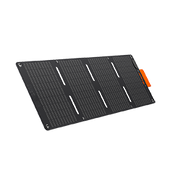
Portable folding or suitcase panels are placed on the ground and connected when needed.
|
Panel Format |
Best for |
Main Trade-off |
Advantages |
Disadvantages |
|
Fixed Rigid |
Frequent touring and automatic charging |
Vehicle often needs to park in sunlight |
Strong durability. Good airflow beneath the panel. Widely available. No daily setup. |
The vehicle may need to remain in the sun. Roof mounting adds height and weight. Fixed orientation cannot follow the sun. |
|
Flexible |
Curved or weight-sensitive roofs |
Heat, bonding and longevity concerns |
Low profile. Lower weight. Suitable for some curved roofs. |
Reduced ventilation can increase temperature. Removal may damage the roof or panel. Lifespan and warranty may be shorter than for rigid modules. |
|
Portable Folding |
Shaded pitches and occasional use |
Setup, security and storage |
Can be moved into sunlight while the vehicle remains shaded. Adjustable angle. Useful across several vehicles or campsites. |
Need setup and storage. Greater theft and trip risk. Must be packed away before travel. |
How Much Energy Will RV Solar Produce in the UK?
The wattage printed on a solar panel is measured under controlled Standard Test Conditions. A 300W panel can therefore reach about 300W only when sunlight, cell temperature and test conditions are favourable. Real output on a campervan or motorhome changes throughout the day.
Key influences include:
- Time of year.
- Latitude.
- Cloud cover.
- Panel angle and orientation.
- Shade from trees or nearby vehicles.
- Panel temperature.
- Dirt, leaves and bird fouling.
- Charge-controller efficiency.
- Battery state of charge.
- Cable losses.
A full battery may also accept less charging power, so low readings do not always mean the panel itself is underperforming.

Summer
Long daylight hours give solar energy for RV systems their strongest chance of replacing normal daily use. A 300–500W array parked in an open, unshaded position may support refrigeration, laptops, lighting and other moderate loads when consumption is controlled.
Campsite shade can change the result quickly. Even a small branch shadow crossing part of a panel may reduce output, particularly where several modules share one string.
Spring and Autumn
Useful generation remains possible, but shorter days and a lower sun angle reduce the total energy collected. Travellers may need to limit high-power appliances, move portable panels during the day or rely more heavily on alternator and hook-up charging.
A larger array can improve resilience, although it cannot guarantee a full recharge after several cloudy days.
Winter
Winter solar is much less dependable. Days are short, the sun remains low and extended cloud can coincide with higher demand for lighting, fans and heating-related controls.
Solar may still maintain a lightly loaded battery or supplement another charging source, but it should not be assumed to support unrestricted off-grid touring throughout the UK winter. A system sized from summer figures alone is likely to disappoint.
|
Condition |
Likely Effect |
|
Clear summer day |
Strongest generation and faster charging |
|
Bright overcast day |
Reduced but still useful output |
|
Heavy cloud and rain |
Low charging power |
|
Partial tree shade |
Potentially substantial reduction |
|
Winter storage |
May maintain the battery if loads are minimal |
|
Flat, dirty panel |
Lower yield than a clean, better-positioned panel |
For realistic planning, compare expected daily watt-hours rather than the highest wattage shown on the controller. UK touring systems should be sized around local seasonal conditions, not output examples from sunnier climates.
Solar, Alternator and Campsite Hook-Up: How They Work Together
A reliable RV solar energy system does not need to depend on one charging source. Solar, the vehicle alternator and a campsite hook-up can all replenish the same leisure battery through suitable charging equipment.
Solar Charging
Solar is most useful when:
The vehicle remains parked for several days.
Panels receive clear daylight.
Daily loads are moderate.
Campsite hook-up is unavailable.
The battery needs steady daytime replenishment.
It is quiet and automatic with a fixed roof array, but output depends on weather, shade and season.
Alternator Charging
Alternator charging becomes valuable when:
The vehicle travels regularly.
Solar conditions are poor.
A larger battery needs faster replenishment.
High daily consumption has reduced the state of charge.
A suitable DC-to-DC charger is installed.
Modern vehicles may use smart alternators, so a simple split-charge relay is not always appropriate. The charger must match the alternator, leisure-battery chemistry and permitted charging current.
Campsite Mains Charging
A 230V hook-up and compatible mains charger are useful for:
Recovering a depleted battery more quickly.
Winter touring.
High daily electricity demand.
Pre-charging before an off-grid stay.
Running appliances while preserving battery reserve.
The hook-up system, charger and vehicle AC installation must use suitable protection and approved connections.
The strongest setup uses whichever energy source is available rather than expecting solar to support every appliance throughout every season. Solar can reduce dependence on driving and hook-up, while alternator and mains charging provide resilience when daylight is limited.

Can RV Solar Run a Fridge?
Yes, but the answer depends on the type of fridge, its daily energy use and the size of the battery and solar array.
Compressor Fridge
A 12V compressor fridge is usually the better match for solar energy for RV systems. It runs from the leisure battery and cycles on and off rather than drawing its rated power continuously. Its consumption depends on:
Ambient temperature.
Ventilation around the compressor.
Thermostat setting.
Fridge size and insulation.
Door-opening frequency.
How much warm food is added.
Battery voltage and wiring quality.
A fridge rated at 50W does not necessarily use 1,200Wh per day. If the compressor runs for eight equivalent hours, daily consumption would be about:
- 50W × 8 hours = 400Wh
In hot weather or with poor airflow, the compressor may run for much longer.
Three-Way Absorption Fridge
A three-way fridge may operate on gas, 12V DC or 230V AC. The 12V setting is often intended mainly for use while driving, when the vehicle’s charging system can support the load.
Running an absorption fridge continuously from the leisure battery can consume substantial energy. Solar may struggle to replace that demand, especially during cloudy weather or winter. Travellers should follow the fridge and vehicle manufacturer’s instructions rather than assuming all three operating modes are interchangeable.
Use Daily Watt-Hours for Sizing
The most reliable method is to measure the fridge’s energy use over 24 hours. A battery monitor or suitable power meter can show how consumption changes with temperature and use.
Panel sizing should then be based on daily watt-hours, not only the fridge’s nameplate wattage. A compressor fridge using 400–600Wh per day may fit within a moderate campervan solar system, while a less efficient or poorly ventilated unit can become the largest continuous load in the vehicle.
Can RV Solar Run Cooking Appliances?
Yes, but cooking appliances are among the most demanding loads in an RV solar energy system. The key distinction is between power and energy.
Power, measured in watts, determines whether the inverter and battery can run the appliance at all. Energy, measured in watt-hours, determines how much battery capacity one cooking session uses.
A 2,000W kettle may operate for only a few minutes, yet it still requires:
An inverter with enough continuous and surge output.
A battery capable of very high discharge current.
Heavy DC cabling and suitable fusing in a fixed 12V system.
Enough stored energy.
A realistic plan for replacing that energy through solar, alternator or mains charging.
For example, a 2,000W kettle running for five minutes uses about:
- 2,000W × 5 ÷ 60 = 167Wh
After inverter losses, the battery may supply closer to 185Wh. Several uses per day can quickly become a significant load.
|
Appliance |
Main Challenge |
|
Low-wattage travel kettle |
More manageable demand, but slower boiling |
|
Domestic kettle |
Very high inverter and battery current |
|
Microwave |
Electrical input may exceed advertised cooking output |
|
Induction hob |
High continuous power during cooking |
|
Air fryer |
High power, although cooking time may be relatively short |
|
Coffee machine |
Heating element plus pump startup |
|
Toaster |
High resistive load with limited flexibility |
A microwave labelled 800W may draw 1,200W or more from the inverter because the advertised figure often refers to cooking output rather than electrical input.
Solar panels do not usually supply these appliances directly. The battery handles the immediate load, while the array replenishes that energy later. For frequent electric cooking, a larger battery bank, higher-voltage system and mixed charging strategy may be more suitable than relying on a modest roof array alone.

Fixed RV Solar System vs. Portable Solar Generator
A fixed solar system offers deeper vehicle integration, while a portable solar generator combines the battery, inverter, charge controller and outlets in one removable unit. Neither approach is automatically better; the decision depends on how often the vehicle is used and whether power is needed elsewhere.
|
Factor |
Fixed van solar system |
Portable solar generator |
|
Installation |
Permanently designed and wired |
Minimal setup |
|
Roof charging |
Automatic whenever panels receive light |
Usually relies on portable panels |
|
Battery |
Separate leisure battery |
Integrated battery |
|
Inverter |
Separate or combined inverter-charger |
Built in |
|
Charge controller |
Separate component |
Built in |
|
Vehicle integration |
High |
Limited unless approved accessories are used |
|
Portability |
Remains with the vehicle |
Moves between van, home and campsite |
|
Expansion |
Depends on system design |
Product-dependent |
|
Maintenance |
Individual components can be assessed separately |
More integrated construction |
|
Best for |
Permanent conversion |
Flexible and occasional touring |
Choose Fixed Solar When:
The campervan is used frequently.
Automatic charging while parked matters.
Fixed lights, pumps and refrigeration are already installed.
Alternator and hook-up charging must work with the same battery bank.
Roof space is available.
Permanent 12V and 230V outlets are required.
A suitable installer can design the protection and cable system.
Choose a Portable Solar Generator When:
The power system must move between vehicles.
Electrical installation should be minimal.
Camping is occasional.
Built-in AC, USB and DC outputs are preferred.
The van can stay in the shade while portable panels sit in sunlight.
The unit will also be used for work or home backup.
Fixed vehicle circuits are unnecessary.
Jackery Solar Generators for RVs
A portable solar generator packages most of the major components into one system. The solar panels recharge the integrated battery, while the built-in inverter and outlets supply appliances directly.
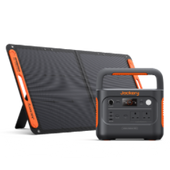
Jackery Solar Generator 2000 v2 for Campervan and Touring Use
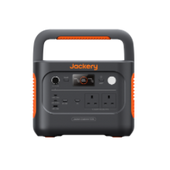
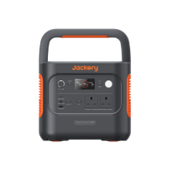
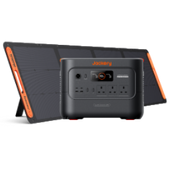
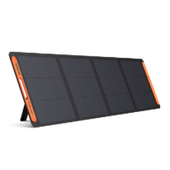
The Jackery Solar Generator 2000 v2 combines the Explorer 2000 v2 portable power station with compatible folding SolarSaga 100W or 200W solar panels, creating an integrated solar-power option for campervan and motorhome touring.

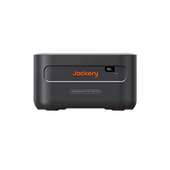
The power station provides 2,042Wh of LiFePO4 battery capacity and a built-in GaN pure sine wave inverter rated at 2,200W continuous AC output, allowing it to support appliances such as a compressor fridge, laptops, televisions, coffee makers, small microwaves and other touring equipment, provided their combined load remains within the output limit.
The UK model includes two 230V AC sockets, one 18W USB-A port, two USB-C ports rated at 100W and 30W, and a 12V vehicle-style outlet. It weighs approximately 38.6 lbs, while its battery is rated for up to 4,000 charge cycles, making it suitable for repeated travel and seasonal off-grid use.
For touring, the solar-generator package provides more flexibility than a permanently fitted roof array because its folding panels can be placed in sunlight while the campervan remains on a shaded pitch.
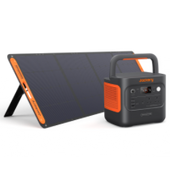
Jackery Solar Generator 3000 v2 for Higher Energy Demand
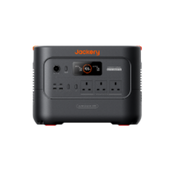
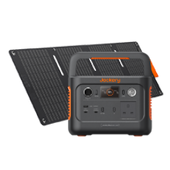
The Jackery Solar Generator 3000 v2 combines the Explorer 3000 v2 portable power station with SolarSaga 200W solar panels, providing a higher-capacity option for campervan and motorhome users with substantial daily energy needs.

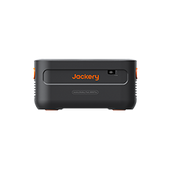
It offers 3,072Wh of LiFePO4 battery capacity, a built-in pure sine wave inverter delivering 3,600W of continuous 230V AC output, and up to 7,200W of surge power. The UK model includes three 230V, 13A AC sockets and eight outputs in total, allowing it to support several devices at once, provided their combined demand remains within the system limits.
At approximately 59.5 lbs, it is larger than the Explorer 2000 v2 but remains removable, so it can also be used at a campsite, worksite or at home. The battery is rated for up to 4,000 charge cycles, while the integrated battery-management system provides protection against risks such as excessive temperature, voltage, current and short circuits.
For touring, the Solar Generator 3000 v2 is better suited to running a compressor fridge, laptops, televisions, coffee machines, microwaves, power tools and compatible cooking appliances, especially where several loads may operate together.
How Long Can a Portable Solar Generator Power RV Appliances?
Use:
- Approximate runtime = usable battery energy × conversion efficiency ÷ appliance power
Assuming roughly 85% usable AC energy:
|
Load |
2,042Wh-class unit |
3,072Wh-class unit |
|
50W average electronics load |
About 34 hours |
About 52 hours |
|
100W fridge and electronics average |
About 17 hours |
About 26 hours |
|
500W cooking or tools |
About 3.5 hours cumulative |
About 5.2 hours cumulative |
|
2,000W appliance |
About 50 minutes |
About 1.3 hours |
These figures are estimates. Compressors cycle, multiple appliances may run together, inverter losses vary and reserve or shutdown limits reduce usable energy. Temperature also affects charging and battery operation.
A portable solar generator simplifies setup, but fixed vehicle wiring, shore-power integration or feeding existing campervan circuits still requires an approved installation route.
Campsite and Wild-Camping Considerations
Solar can make touring more flexible, but the campsite layout, local rules and safe equipment placement still shape how useful the system will be. A technically capable setup can perform poorly if the vehicle is parked under trees or the panels cannot be deployed safely.
Campsite Shade
Tree cover may keep the van cooler, yet it can sharply reduce solar generation. Fixed roof panels are especially affected because the whole vehicle must remain in sunlight.
Portable panels can sometimes be placed in a brighter area while the van stays shaded. Keep leads tidy and within the pitch. Cables should not cross access roads, neighbouring pitches or walking routes where they could create a trip hazard or be damaged by vehicles.
Electric Hook-Up
Solar can remain useful on a hook-up pitch by maintaining the leisure battery and reducing demand on the mains charger.
Use the campsite supply only through the vehicle’s approved hook-up equipment and protective devices. Never connect an inverter to the vehicle’s external hook-up inlet or create a homemade lead to energise fixed circuits. This can defeat isolation and changeover protection and may expose other equipment to dangerous voltage.
Security
Portable solar equipment is valuable and easy to remove. Where possible:
Lock panels and power stations to a secure point.
Keep the main unit inside the vehicle.
Avoid leaving equipment visible when the pitch is unattended.
Record serial numbers.
Pack panels away before driving or during strong wind and severe weather.
Responsible Parking and Camping
Having solar energy for RV use does not create a right to park or stay overnight. Check campsite rules, landowner permission, parking restrictions and local by-laws before setting up.
Panels should not block paths, entrances or emergency access. Avoid placing them on sensitive vegetation or outside the permitted pitch boundary. Responsible positioning protects the equipment, other visitors and the location itself.
FAQs
The following are the frequently asked questions about the RV solar energy:
1. What is RV solar energy?
RV solar energy is electricity generated by solar panels fitted to or used beside a campervan, motorhome or caravan. The panels normally charge a leisure battery through a solar charge controller. That stored energy can then supply 12V equipment directly or power 230V appliances through an inverter.
2. Is 400W solar enough for an RV?
It can be enough for moderate touring loads such as a compressor fridge, laptops, lighting, phones and a water pump, particularly in favourable summer conditions. It may not fully replace daily use during poor weather, heavy shade or winter. The correct answer depends on daily watt-hour consumption and battery capacity.
3. Is 100W of solar enough for a campervan?
A 100W panel may support light weekend use, battery maintenance, phones, LED lighting and small electronics. It is usually limited for continuous refrigeration, remote working or longer off-grid stays unless alternator or mains charging is also available.
4. Is 200W of solar enough for a motorhome?
A 200W array can cover modest loads in good weather, including lighting, electronics and part of a compressor fridge’s daily use. Larger motorhomes often consume more energy, so refrigeration, television, pumps and inverter loads should be measured before relying on 200W alone.
5. Can solar panels run a motorhome without a battery?
Only in limited specialist arrangements. Standard motorhome systems use a battery to stabilise voltage and store energy because solar output changes constantly. Without a battery, appliances may stop when cloud passes or demand exceeds panel output. The charge controller and equipment must also be designed for battery-free operation.
6. Can RV solar run an electric kettle?
The solar panels do not normally run the kettle directly. A sufficiently large battery and inverter supply the immediate load, while solar replenishes the energy later. A typical 2,000–3,000W UK kettle creates very high inverter and battery-current demand, so a low-wattage travel kettle is often easier to support.
7. Are flexible solar panels good for campervans?
They can suit curved or weight-sensitive roofs because they are light and low profile. However, bonded panels receive less rear ventilation and may run hotter. Removal, waterproofing, warranty length and long-term durability should be compared with rigid framed panels.
8. Can solar panels overcharge a leisure battery?
They can if connected without a suitable charge controller or if the controller uses the wrong charging profile. A correctly specified PWM or MPPT controller regulates charging voltage and current for the battery chemistry. Settings should match lead-acid, AGM, gel or lithium requirements, and any temperature limitations should be followed.
Final Thoughts
A dependable solar energy for RV system begins with three figures: normal daily consumption, usable battery capacity and realistic seasonal solar generation. Once those are known, the choice between fixed panels, portable panels and an integrated solar generator becomes much clearer. Light touring loads can be supported by a modest setup, while refrigeration, remote working and electric cooking require larger batteries and mixed charging sources.
Solar offers quiet, low-maintenance energy, but it should not be expected to replace alternator or mains charging in every UK season. Size the system around watt-hours rather than headline panel power, allow reserve for poor weather and choose equipment that matches the vehicle’s electrical layout and travel style.


