













![[Over £1200 Tier Gift] Bluetooth Speaker with Phone Stand - shipped Separately](http://uk.jackery.com/cdn/shop/files/Portable_Bluetooth_Speaker_with_Phone_Stand_2.png?v=1781595581&width=170)















Looking at an electricity bill or backup power specs can feel like reading a foreign language. Terms like watts, kilowatts, and kilowatt-hours get tossed around, leaving many UK homeowners confused. And that confusion isn’t just annoying; it can be costly.
Misunderstanding these basic power units can lead to higher bills and poor choices when buying a home backup system. This guide breaks down the essentials, giving you the clarity and confidence to choose the right power solution to keep your home running in any situation.
The Core Concepts: Decoding Power (kW) vs. Energy (kWh)
Understanding the difference between power and energy is the first step to managing your home’s electricity use. They’re closely related but measure different things—and knowing the distinction is essential for making sense of any energy unit.
What Is Power (Watts/kW)?
Power is the instantaneous rate at which electricity is being used at any single moment. It is measured in Watts (W) or, for larger amounts, Kilowatts (kW), where 1 kW equals 1,000 W.
Think of it as the speed of water flowing from a tap. A high-wattage appliance, like a kettle, is like a fully open tap, demanding a large, fast flow of electricity to function.
The kW rating of an appliance is crucial because it determines if a power source can run it at all. For example, a typical kettle requires between 2-3 kW to boil water; a power source with a lower output simply won't be able to handle the demand.
What is Energy (Watt-hours/kWh)?
Energy is the total amount of electricity consumed over a period of time. It is measured in Watt-hours (Wh) or, more commonly on your utility bill, Kilowatt-hours (kWh).
Using the same water analogy, energy is the total volume of water you’ve collected in a bucket from that tap over a set time. It’s not about the speed of the flow, but the total quantity used.
Your electricity bill is calculated based on the total kWh you consume. For a backup power station, the kWh rating determines its capacity—how long it can power your devices before needing a recharge. You can learn more about how much one kWh of electricity is to better understand your bills.
How Are Power and Energy Related?
The relationship between power and energy is straightforward and can be expressed with a simple formula. Understanding this helps you see how appliance ratings translate into actual consumption.
Energy (kWh) = Power (kW) × Time (hours)
A 1 kW electric heater running for 3 hours uses 3 kWh of energy (1 kW x 3 h). Similarly, a 0.1 kW television running for 10 hours uses 1 kWh of energy (0.1 kW x 10 h).

How Do You Convert mAh to Wh?
Small device batteries are often measured in milliamp-hours (mAh), which can be confusing when comparing them to a large power station's capacity in Watt-hours (Wh). You can convert this easily to make a direct comparison.
Wh = (mAh × Voltage) / 1,000
Most phone batteries have a voltage of around 3.7V. A 5,000 mAh phone battery, therefore, has a capacity of about 18.5 Wh. This shows that a typical phone battery holds a tiny fraction of the energy needed for a home, which often uses several kWh per day.
How to Measure Your Home's Real-World Energy Needs
Before you can choose a backup power solution, you must first conduct a simple audit of your home's energy usage. This process will tell you exactly what size system you need to keep your essential devices running during an outage. This is a crucial step in understanding the power of units in a practical sense.
Step 1: Identify Your Essential Appliances
Make a list of the critical devices you cannot live without during a power cut. This list is unique to every household but often includes items for safety, communication, and food preservation.
Common essentials include a refrigerator, a few lights, a WiFi router, a phone charger, and any necessary medical equipment like a CPAP machine.
Step 2: Find the Power Draw (Watts) of Each Appliance
Next, find the power consumption, measured in Watts (W), for each item on your list. The most accurate figure is usually found on a nameplate or sticker on the appliance itself or in its user manual.
If you can't find it, the table below provides typical power consumption ranges for common UK household appliances.
|
Appliance |
Typical Power Consumption (Watts) |
|
Kettle |
2,000 - 3,000 W |
|
Microwave |
800 - 1,500 W |
|
Refrigerator |
100 - 400 W (cycles on/off) |
|
TV (LED) |
50 - 150 W |
|
WiFi Router |
5 - 10 W |
|
Space Heater |
1,000 - 2,500 W |
Step 3: Calculate Your Total Energy Need (kWh)
Now, you will calculate your total daily energy requirement in kWh. This figure determines the battery capacity you'll need.
First, list your essential appliances and convert their power from Watts to Kilowatts (e.g., a 400 W fridge is 0.4 kW). Then, estimate how many hours each appliance will run over a 24-hour period.
Multiply the power (kW) by the run time (hours) for each device to find its daily energy use in kWh. Finally, add up the kWh values for all appliances to get your total daily energy requirement. This figure is a good starting point for understanding how many kWh a house uses in the UK.
Step 4: Determine Your Peak Power Need (kW)
Your peak power need is the highest amount of power you might draw at any single moment. This determines the minimum output power your backup system must have.
To find this, add up the Watts of all the appliances that you might realistically run at the same time. For instance, your refrigerator (400 W) might be running while you also have a TV (100 W) and a light (15 W) on. Your peak power need in this scenario would be 515 W (0.515 kW).
Sizing Your Solution: Matching a Power Station to Your Needs
With your calculations complete, you are now equipped to choose a power station that perfectly matches your requirements. The key is to translate your needs into the two main product specifications: capacity and output.
How Do Your Needs Translate to Product Specs?
● Capacity (kWh): The total daily energy needed (kWh) you calculated in Step 3 directly corresponds to the battery capacity you need. If your essential appliances require 3 kWh of energy per day, you should look for a power station with a capacity of at least 3 kWh to get you through a full day.
● Output (kW): The peak power needed (kW) you calculated in Step 4 determines the required inverter output of the power station. If your simultaneous appliances add up to 2,000 W (2 kW), you must choose a unit with at least a 2 kW continuous output rating.
● Surge Power: Appliances with motors, like refrigerators and pumps, require a brief but significant burst of extra power to start up. This is called surge or peak power. Always check that a power station's surge power rating is high enough to handle the startup load of your largest motor-driven appliance.
Which Jackery Solutions Match Different Needs?
Jackery offers a range of solar generators designed to meet various home backup needs, from running a few essentials to powering significant portions of your home.
For Significant Home Backup (High Power & Capacity)
● Jackery Solar Generator 3000 v2
● Capacity: 3072Wh (3.07 kWh) LiFePO4 battery with a 10-year lifespan.
● Output: 3600W continuous output.
● Surge Power: 7200W peak surge.
This unit is a powerhouse capable of running demanding appliances like a refrigerator (200W) for 24-48 hours or a hair-dryer (1200W) for 2 hours. It is also compatible with a manual transfer switch for seamless integration into your home's electrical system, providing reliable power automatically.
For Essential Loads and High-Power Appliances
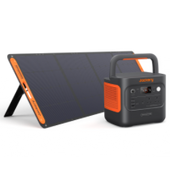
● Jackery Solar Generator 2000 v2
● Capacity: 2042Wh (2.04 kWh).
● Output: 2200W continuous output.
● Key Features: <20ms UPS function, 1.7-hour supercharging.
This model is an excellent all-rounder, perfect for running daily essentials like a refrigerator (300W for 5 hours), a TV, and even a high-draw electric stove (1000W for 2 hours). Its ultra-fast uninterruptible power supply (UPS) function switches over in less than 20 milliseconds, ensuring devices like computers and medical equipment never lose power.
For Lighter, Portable Needs
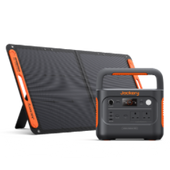
For users who only need to power a few key devices like a router, lights, and laptops, a more compact option may be suitable. The Jackery Solar Generator 1000 v2 offers a 1070Wh capacity and 1500W output, providing a reliable and portable solution for basic needs.
Take Control of Your Home Energy
You now have the practical tools to audit your own home, calculate your specific needs, and make an informed decision without confusion. It is also useful to understand how to convert units like kWh to MWh or kWh to Joules for broader energy comparisons. This knowledge empowers you to prepare for any outage with certainty.
Use the steps in this guide to calculate your requirements and explore the recommended Jackery Solar Generator 2000 v2 and Jackery Solar Generator 3000 v2. They are reliable, powerful solutions designed to bring security and peace of mind to UK homes.
Frequently Asked Questions
Q1: How do I account for phantom load (standby power) when calculating my total energy needs?
A1: Phantom load is the power devices use in standby mode. You can use a plug-in power meter to measure this for key electronics and add the cumulative total to your daily kWh calculation for greater accuracy.
Q2: What's the typical lifespan of a home backup power station, and what factors affect its longevity?
A2: Lifespan is measured in charge cycles, with LiFePO4 batteries (like in the Jackery Explorer 3000 v2) lasting over 4,000 cycles or 10+ years. Longevity is affected by battery chemistry, usage frequency, and avoiding extreme temperatures.
Q3: Can I connect multiple solar panels to increase charging speed for these power stations, and what are the limitations?
A3: Yes, you can connect multiple panels in series or parallel to increase charging speed, but you must stay within the power station's maximum input wattage and voltage limits. The built-in MPPT controller optimises the charge automatically.
Q4: How does the efficiency of my home appliances impact my overall energy consumption, and are there specific types of appliances I should prioritize upgrading?
A4: Highly-rated energy-efficient appliances use significantly less kWh, reducing your bills and backup power needs. Prioritise upgrading high-usage items like refrigerators, freezers, and washing machines for the biggest impact.
Q5: What are the safety considerations I should be aware of when using a portable power station inside my home, especially regarding ventilation and placement?
A5: Always ensure the unit has adequate ventilation by not obstructing its cooling fans. Keep it away from flammable materials and liquids, and operate and store it within the recommended temperature range specified in the user manual.


