





































Quick Answer: A 5,000W generator cannot power an entire UK house. It provides roughly 21.7 amps at 230V — enough for survival essentials like a fridge, lights, router, and furnace fan (typically 1,000–3,000W combined), but far short of what central heating, electric ovens, or water heaters demand. Think of it as emergency backup for critical circuits, not a whole-house replacement.
Key Takeaways
-
A 5,000W generator delivers approximately 4,000W of usable continuous power after applying the 80% capacity rule — enough for essential circuits, not whole-house operation
-
Motor-driven appliances create "surge traps": a fridge and furnace fan starting simultaneously can spike to 3,400W, pushing dangerously close to the generator's 6,250W peak limit
-
Central air conditioning, electric water heaters, and electric showers are categorically impossible on a 5,000W generator — these require 3,500–8,500W individually
-
Safe connection requires a manual transfer switch (£500–£1,500 installed) — backfeeding through a wall outlet is illegal and can kill utility workers
-
Fuel logistics demand refuelling every 8–12 hours, making extended outages a planning challenge rather than a plug-and-play solution
What a 5,000W Generator Can Actually Power in a UK Home
A 5,000W generator running at 230V delivers 21.7 amps. That's enough for a carefully managed survival circuit — but nowhere near what a modern household draws during normal operation (most UK homes pull 3,000–8,000W simultaneously).
The 80% capacity rule changes the maths significantly: sustained operation at full load shortens engine life and increases failure risk, making the practical limit 4,000W continuous.
Motor-driven appliances don't just need running watts — they need 2–3 times that figure for the split-second starting surge. A fridge drawing 700W while running pulls 2,100W to start the compressor. A generator's peak rating — usually 6,250W for a 5,000W unit — is the ceiling for such surges.
Most UK households drawing 1,000–3,000W for survival essentials find a 5,000W generator adequate for partial backup, but adding an electric kettle (3,000W) to a circuit already running a fridge and furnace fan crosses the line immediately.
Calculating Your Home's Essential Load: The "Highest Single Surge" Rule
The "Highest Single Surge" rule calculates your essential load by adding the single largest starting surge to total running watts, then applying a 20% safety buffer.
Step 1: List Running Watts of All Essential Appliances
A typical UK survival circuit looks like this:
|
Appliance |
Running Watts |
|
Fridge-freezer |
700W |
|
Furnace fan |
800W |
|
LED lights (10 bulbs) |
50W |
|
Wi-Fi router |
15W |
|
Phone/laptop charging |
100W |
|
Total Running |
1,665W |
Step 2: Identify the Single Highest Starting Surge
Your calculation only needs the single highest surge number, not the sum of all surges. The formula:
(Total Running Watts + Highest Single Surge) × 1.2 = Minimum Generator Size
Example: (1,665W running + 2,100W fridge surge) × 1.2 = 4,518W required. That lands within a 5,000W generator's capabilities — but with only 482W of headroom. Add a sump pump (1,300W surge) and you're immediately over the line.
Step 3: Apply the 20% Safety Buffer
The 1.2 multiplier accounts for voltage drops, stale fuel, and reduced generator performance in cold weather or at altitude. Skipping this buffer risks a breaker trip on a January night. A load calculation sheet — even a handwritten one taped to the generator — keeps you honest. Prioritise circuits and manually switch off non-essentials before adding temporary loads.
What You Can (and Can't) Run on a 5,000W Generator
A 5,000W generator can run a survival kit of fridge, lights, router, and furnace fan simultaneously, but high-wattage appliances like kettles and microwaves must take turns, and central AC, electric water heaters, and electric showers are impossible.
Can Run Simultaneously
A survival kit of fridge-freezer, LED lights, Wi-Fi router, TV, laptop, and a furnace fan uses roughly 1,200–1,500W continuous.
Can Run One-at-a-Time
A microwave (1,200W), kettle (3,000W), air fryer (1,500W), or a 10,000 BTU window air conditioning unit (~1,500W) can run — but never together. The kettle consumes 75% of your usable 4,000W capacity in a single appliance. Turn off the furnace fan before boiling water.
Cannot Run — No Exceptions
|
Appliance |
Running Watts |
Why It's Impossible |
|
Central AC |
3,500–5,000W |
Exceeds running limit alone; surge is 7,000W+ |
|
Electric water heater |
4,500W |
Consumes 113% of usable capacity |
|
Electric oven |
2,500W |
Theoretically borderline but leaves zero headroom |
|
Tumble dryer |
2,500W |
Same problem — no room for anything else |
|
Electric shower |
8,500W |
Draws 37 amps at 230V; your generator outputs 21.7A |
A 10,000 BTU window unit draws roughly 1,500W — a fraction of central AC's demand. It won't cool the whole house, but one habitable room beats none.

Smart Load Management: How to Avoid Overloading
-
Start high-surge appliances first: Turn on the furnace fan or well pump, let it reach steady-state, then add the fridge. The generator's peak capacity handles one major surge at a time — not two overlapping spikes.
-
Never run two high-draw appliances simultaneously: A microwave and kettle together draw 4,200W — above your continuous rating before accounting for anything else.
-
Operate at 70–80% capacity: Running at 4,000–4,500W instead of the full 5,000W reduces heat stress, improves fuel efficiency, and extends lifespan. Generators at 30–50% load achieve significantly better fuel consumption than units near maximum.
-
Stagger appliance use in 20–30 minute blocks: Run the kettle for five minutes. Wait. Run the microwave. Wait. Charge devices during the gaps.
Safe Connection Methods: Transfer Switch vs. Extension Cords
Transfer Switch: The Only Code-Compliant Method
-
How it works: A manual transfer switch physically isolates selected circuits from the grid before connecting generator power, preventing backfeeding — the lethal situation where generator electricity travels back through your meter and energises power lines that utility workers assume are dead.
-
Cost: A 6-circuit manual transfer switch typically costs £500–£1,500 installed in the UK and must be installed by a qualified electrician.
-
Neutral-ground bonding: Neutral and ground must NOT be bonded at the generator if the transfer switch is at the main panel. Many portable inverter generators arrive with a bonded neutral, requiring the bonding jumper to be disconnected — get this wrong and you create a shock hazard.
Extension Cords: Simple but Limited
Heavy-duty 12-gauge outdoor-rated extension cords work for individual appliances but leave hardwired circuits like your furnace and well pump unusable.
What Never to Do
Backfeeding through a standard wall outlet or dryer socket — the "suicide cord" approach — is illegal and deadly. It energises dead power lines, electrocuting lineworkers repairing the grid.
Fuel, Runtime, and Safety: The Realities of Generator Use
Runtime Realities
-
Petrol generators run 8–12 hours on a full tank at half load. Extended outages demand multiple fuel containers, stabiliser, and a rotation schedule.
-
Dual-fuel models running on propane store indefinitely without degradation and burn cleaner, reducing carburettor maintenance — but with roughly 10% lower maximum wattage compared to petrol.
The 20-Foot Rule
|
Requirement |
Detail |
|
Distance |
At least 20 feet from doors, windows, and vents |
|
Exhaust direction |
Must face away from the house |
|
Wind consideration |
Wind can push CO through a cracked downwind window |
|
Refuelling cooldown |
Wait 20 minutes for engine to cool |
Minimum Safety Equipment
-
Carbon monoxide detector: A battery-operated CO detector (£15) inside the house is non-negotiable. Install one on every floor and test monthly — the generator's built-in CO sensor is a backup, not a primary defence.
-
Fuel storage: Use a proper metal or approved plastic container, stored in a shed or garage away from ignition sources.
-
Fuel rotation: Petrol degrades within 3–6 months without stabiliser. Rotate your supply or you'll discover a tank of varnish when you need it most.
Jackery SolarVault 3 Series: A Different Approach to Home Backup

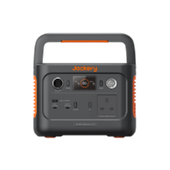
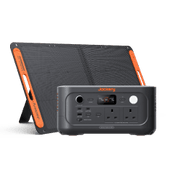
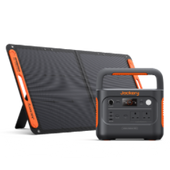
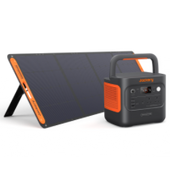
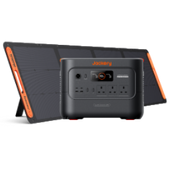
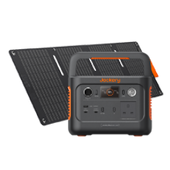
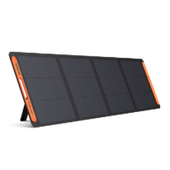
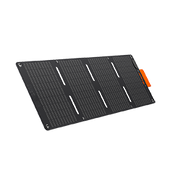
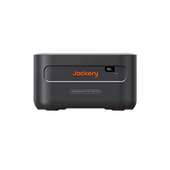
Jackery's upcoming SolarVault 3 Series offers silent, emission-free home energy storage that integrates with solar panels, eliminating the refuelling cycle of petrol generators. The system aims to store energy during the day and supply it during outages or peak-rate evening hours — no petrol cans, no CO risk, no 8-hour refuelling alarm. When paired with solar, it can recharge silently each day, enabling indefinite backup without supply chain dependency — a fundamentally different proposition than a generator tethered to finite fuel reserves.
Key Features to Look for in a 5,000W Generator
|
Feature |
Why It Matters |
|
Inverter technology |
Clean power with total harmonic distortion under 3%; protects sensitive electronics; quieter and more fuel-efficient at partial load |
|
Digital wattage display |
Shows real-time wattage to stay within 70–80% capacity sweet spot |
|
230V output |
Essential for connecting to house wiring through a transfer switch |
|
Dual-fuel capability |
Propane stores indefinitely; fuel flexibility during week-long outages |
|
Quiet operation under 60–65 dB |
Makes the 20-foot placement rule practical; built-in wheels and handles aid positioning |
Limitations: What Generator Owners Wish They'd Known
-
The surge trap catches almost everyone. Two appliances starting simultaneously overwhelms a generator's peak rating. The solution is manual load management requiring everyone in the household to understand the rules.
-
Electric heating and central AC are off the table. UK homes with electric heating or heat pumps will not stay warm on a 5,000W generator — a fundamental mismatch between expectation and capability.
-
Fuel logistics dominate extended outages. Petrol stations without power can't pump fuel. A stored supply of 20–40 litres represents 24–48 hours of runtime at half load.
-
Noise and theft are real considerations. A generator at 65 dB advertises "power here" to every neighbour within 100 metres. Portable units can walk away in seconds unless chained to something immovable.
Frequently Asked Questions (FAQ)
How long does a 5kW generator typically last?
A well-maintained 5kW generator can provide 2,000–3,000 hours of operation before requiring major overhaul, with most portable units exceeding 1,500 hours under regular maintenance.
Can I parallel two 5kW generators to get 10kW?
Only if both generators are specifically designed for parallel operation and you use the manufacturer's parallel kit — connecting mismatched units without proper synchronisation will cause electrical damage.
What is the best fuel to store for a 5kW generator?
Propane stores indefinitely without degradation or carburettor gumming, though it reduces maximum wattage output by roughly 10% compared to fresh petrol.
Are there UK noise restrictions for running a generator?
Most UK residential areas enforce local noise nuisance laws after 11 PM, with council-specific decibel limits typically around 55 dB during night hours — quieter than most portable generators produce.
Can a 5kW generator run a standard 3kW immersion heater?
A 5kW generator can run a 3kW immersion heater alone, but all other high-load appliances must be switched off first to stay within the generator's 4,000W continuous 80% limit.


