





























































When planning electrical loads, choosing equipment, or being ready for backup power in the UK, it's important to know how to change kVA to amps. It helps you figure out how much electricity your appliances will need and if your power supply can safely manage that much.
This is quite helpful when comparing current portable power options like the Jackery Explorer 2000 v2 and Jackery Explorer 1000 v2, which provide clean, quiet power for homes, caravans, and outdoor usage. You can match your power demands with the proper capacity, avoid system overloads, and make better decisions for everyday and emergency power consumption if you understand this conversion.
|
Key Takeaways: |
|
l To correctly size electrical systems and choose power equipment that can handle real-world loads without overloading, you need to know how to convert kVA to amps. l In contrast, kVA (kilovolt-amperes) is a measure of perceived power, representing the total apparent power in an electrical circuit. l Amps = (kVA x 1,000) ÷ Volts l kVA (kilovolt-amperes) is a measure of perceived power, representing the total apparent power in an electrical circuit. This number is derived as the product of kilovolts (kV) and amperes (A). l In the UK, conventional home voltage is often 230V, but commercial line-to-line voltage is frequently 400V. l The Jackery Explorer 2000 v2 and Jackery Explorer 1000 v2 are examples of modern power stations that illustrate how kVA-to-amps information may be used in real life, from home backup to travel off the grid. |
Understanding KVA and Amps in Electrical Systems
Amperes, often known as amps, are the fundamental units for measuring electric current or the passage of electrical charge. This particular unit is required when calculating the volume of electricity flowing via a conductor. Professionals must determine circuit capacity to ensure that they are neither overworked or underutilised in a power system.
In contrast, kVA (kilovolt-amperes) is a measure of perceived power, representing the total apparent power in an electrical circuit. This number is derived as the product of kilovolts (kV) and amperes (A), without regard for the phase angle between them. Because it reflects the overall load on a system, kVA is an extremely useful statistic for determining the capacity of electrical facilities, especially for designing cables or selecting appropriate generators.
Both kVA and amps are required for the proper planning, construction, and operation of electrical infrastructure, since they play an important role in ensuring efficiency and safety. To precisely match power production with real consumption, converting from kVA to amps is not only common, but also required for a variety of electrical engineering and maintenance operations.
How to Convert kVA to Amps?
Understanding the link between power and current is critical for any electrical design. The process of converting kva to amps is determined by two essential factors: the kind of electrical system (single-phase or three-phase) and its operating voltage.
Each configuration needs a precise calculation. The following is a technical description of how to convert kVA to amps per phase in common UK setups.
To guarantee accuracy when estimating electrical loads, follow these three main steps:
Identify the System Type: Determine if the environment has a conventional single-phase or a more robust three-phase industrial supply.
Confirm the Voltage: In the UK, conventional home voltage is often 230V, but commercial line-to-line voltage is frequently 400V.
Apply the Correct Formula: To get the final amperage, use mathematical multipliers (such as 1,000 to convert kilo-units).

Single-Phase kVA to Amps Conversion
For those working with a single-phase AC system, which is the standard for most UK households and smaller businesses, the method is straightforward. The following formula allows for a quick calculation:
Amps = (kVA x 1,000) ÷ Volts
Example: If a demand of 5 kVA is placed on a 230V single-phase system, the calculation would be (5 × 1,000) ÷ 230, resulting in approximately 21.74 amps. Consequently, a system capable of handling at least 22 amps would be required.
Three-Phase kVA to Amps Conversion
In larger buildings, industrial facilities, or commercial areas, the load is divided over three wires. This requires a more complex calculation involving two distinct voltage considerations.
Line-to-Line (L-L) Voltage: This is measured between any two of the three phases, commonly 400V in the UK. For a balanced three-phase load (such as a motor), use this formula:
Amps = (kVA x 1,000) ÷ (1.732 x VL-L)
Example: A 10 kVA demand on a 400V three-phase supply results in (10 × 1,000) ÷ (1.732 × 400), which equals approximately 14.44 amps per phase.
Line-to-Neutral (L-N) Voltage: This is the voltage between one phase and neutral, typically 230V. If three single-phase loads are fed from a three-phase system, the kVA is distributed across the phases:
Amps = (kVA x 1,000) ÷ (3 x VL-N)
Example: A 9 kVA load distributed across a 230V system results in (9 × 1,000) ÷ (3 × 230), which equals 13.04 amps per phase.
Quick kVA to Amps Estimations (at 230V/400V)
|
Total kVA |
Single Phase (230V) |
Three Phase (400V L-L) |
|
1 kVA |
4.35 Amps |
1.44 Amps |
|
5 kVA |
21.74 Amps |
7.22 Amps |
|
10 kVA |
43.48 Amps |
14.44 Amps |
|
20 kVA |
86.96 Amps |
28.87 Amps |
How to Convert Amps to kVA?
It's just as vital to do the opposite calculation to convert amps to kVA in order to find out the overall capacity of an electrical installation. If you know how to find the apparent power (kVA) from a given current (Amps), you can make sure that the system stays within its safe working limits, whether you're in charge of a domestic supply or an industrial site.
You should follow these procedures to find out the system's kVA rating correctly:
Measure the Amperage: Use a calibrated ammeter to see how much current is flowing through the circuit.
Check the System Voltage: Find out if the UK supply is single-phase (usually 230V) or three-phase (usually 400V).
Calculate VA First: Multiply the amps by the volts to get Volt-Amperes (VA).
Final Conversion: Divide the result by 1,000 to reach the final kVA value.
Single-Phase Amps to kVA Formula
In a standard UK domestic setting, the calculation is simple. One can use the following formula to determine the kva to amps relationship in reverse:
kVA = (Amps x Volts) ÷ 1,000
Example:
If a piece of equipment draws 30 amps on a standard 230V supply, the calculation would be:
(30 × 230) ÷ 1,000 = 6.9 kVA.
Three-Phase Amps to kVA Formula
For industrial applications where three-phase power is utilised, the calculation must account for the square root of three (1.732) for line-to-line connections.
Formula (Line-to-Line):
kVA = (Amps x Volts x 1.732) ÷ 1,000
Example:
If an industrial motor draws 25 amps on a 400V three-phase supply, the kVA would be:
(25 × 400 × 1.732) ÷ 1,000 = 17.32 kVA.
Practical Examples of kVA to Amps Conversion
Understanding the mathematical formulae is the first step; however, seeing how they apply to real-world UK installations provides a clearer picture. Below are several practical examples demonstrating how a professional would calculate the relationship between kVA to amps across various systems.
Example 1: Installing a Single-Phase Electric Heater
Consider the installation of a 7 kVA single-phase electric heater, powered by a standard 230V UK power source. To determine the required current-carrying capacity of the circuit, the following calculation is performed:
Amps: (7 × 1,000) ÷ 230 = 7,000 ÷ 230 ≈ 30.43 amps
In this scenario, the system requires a circuit capable of handling approximately 30.43 amps. According to UK wiring regulations, a professional would typically select a 32A circuit breaker and ensure the cabling is rated appropriately to prevent overheating.
Example 2: Three-Phase Commercial Air Conditioning
For a commercial setting, one might need to size the supply for a 15 kVA three-phase air conditioning unit connected line-to-line on a 400V system. The calculation for the kVA to amps conversion per phase is as follows:
Amps: (15 × 1,000) ÷ (1.732 × 400) = 15,000 ÷ 692.8 ≈ 21.65 amps
Each phase will carry roughly 21.65 amps. To provide a safe operating margin and account for the initial inrush current of the compressor, a 25A triple-pole breaker per phase would typically be recommended.
Example 3: Line-to-Neutral Three-Phase Lighting Circuits
In a large office or warehouse, a lighting arrangement might be uniformly distributed over three phases, drawing a total of 12 kVA. If each phase delivers power via a line-to-neutral connection at 230V, the current per phase is calculated:
Amps: (12 × 1,000) ÷ (3 × 230) = 12,000 ÷ 690 ≈ 17.39 amps
Each phase carries approximately 17.4 amps. A 20A circuit per phase would generally be sufficient, allowing for a standard safety margin and potential load diversification.
Example 4: Selecting a Portable Power Station for Home Backup
In the event of a power outage, many UK residents look to portable solutions to keep essential appliances running. Instead of traditional fuel-powered units, a high-capacity solar generator (a portable power station paired with solar panels) is often used to support essentials like a fridge, Wi-Fi router, and kitchen appliances.
If a total backup demand is estimated at 7 kVA to ensure a household remains comfortable and connected, the amperage on a standard 230V single-phase supply would be:
Amps: (7 × 1,000) ÷ 230 ≈ 30.43 amps
When performing this kVA to amps calculation for backup power, it is vital to ensure the chosen power station has a continuous output rating that matches or exceeds these requirements to handle the combined load of the connected devices.
Understanding the Importance of Converting KVA to Amps
Converting kVA to amps is critical for a variety of reasons, including assuring equipment compatibility, optimising energy use, improving safety, and simplifying effective maintenance. Here's why understanding this conversion is important:

Keeping Equipment Compatible
Electrical equipment has unique power requirements that must be carefully matched to the electrical system's capacity in order to avoid operational concerns. Converting kVA to amps allows you to establish if a certain piece of equipment will operate safely and effectively within the system's present capacity.
When incorporating solar generators into your house electrical system, for example, it is critical to verify that the generator's output (expressed in kVA) fits your home's current requirements (expressed in amperes). For example, if you want to connect a 5 kVA solar generator to a single-phase home system that runs on 240 volts, you must determine the current it can handle to assure compatibility.
Using the formula: Amps = kVA × 1000/Voltage, the generator can generate around 20.83 amps, which should be suitable with the main service panel's capacity, preventing overloads or underutilisation.
Optimising Energy Efficiency
Efficient energy consumption is both cost-effective and ecologically beneficial. Calculating the right amperage based on kVA values aids in the construction of more efficient electrical systems. This conversion aids in knowing how much load an electrical system can take without wasting energy due to excessive or inadequate current flow.
Because of the limited energy storage capacity, portable power stations used in distant applications such as camping or fieldwork must be efficient.
This conversion allows you to calculate how many things it can power at once, such as a small refrigerator, your laptop and phone, and a few lights. This guarantees that you utilise it more efficiently while without surpassing its present capacity.
Improving Electrical Safety
Safety in electrical systems is critical. Excess current can cause overheating, resulting in fires or damage to electrical cables and devices.
On the other side, insufficient current can cause electrical appliances to function poorly, putting strain on system components. Converting kVA to amps ensures that the current flowing through the system is not too high or too low, resulting in a safe working condition.
Fault Identification and System Maintenance
Understanding the flow of electrical current (amps) in proportion to perceived power (kVA) is critical for detecting problems and performing routine maintenance.
For example, if a system often trips or fuses blow more frequently than they should, knowing the ampere load can assist determine if the problem is due to an overload or another defect in the system.
Regular checks and balances, aided by precise kVA to amp conversions, ensure the lifetime and dependability of electrical systems.
Single-Phase vs. Three-Phase Power: What's the Difference?
Electrical power distribution is classified into two types: single-phase and three-phase systems, each with its own set of characteristics. Knowing the distinction is critical for understanding how they affect conversions.
Configuration
Single-Phase: Consists of two wires, one phase and one neutral, and is used in residential structures to power lights and appliances.
Three-Phase: Contains three wires, each transmitting alternating current 120 degrees out of sync. This ensures balanced and efficient power supply, which is ideal for industrial equipment applications.
Power Delivery
Single-Phase: Power flow changes impair performance while supporting higher-power consumption workloads.
Three-Phase: Provides consistent, efficient power that is suited for heavy machines and industrial applications.
Efficiency
Single-Phase: Because of voltage fluctuations, it is less efficient in delivering power to large applications.
Three-Phase: Handles bigger loads effectively and with little energy waste.

How to Choose the Right Generator Using Conversions?
When purchasing a generator, you should use conversion procedures to ensure that it meets your power requirements. To compute the essential measures for selection, generators must first analyse their power requirements, followed by understanding their power ratings.
Types of Power
The kVA (Kilo-Volt-Amperes) unit measures total power capacity, which includes active and reactive power. This value is used to understand a generator's total capacity.
The kW (kilowatt) unit is used to determine the useable power required for work performance.
Power Factor
In kVA-to-kW conversions, the power factor (PF) is crucial. It indicates the generator's efficiency in transforming visible power into practical work. For example, the precise power output from a generator rated 100 kVA working with a factor of 0.8 is:
KW = 100 × 0.8 = 80 kW
How to Pick the Best Portable Power Station for Your Needs?
People in the UK are now using portable power stations instead of traditional generators for backup power and off-grid use. These stations are cleaner, quieter, and more handy. Knowing how to convert kVA to amps can help you pick a power station that can safely run your appliances without overloading or wasting energy.
Portable power stations, like Jackery Portable Power Stations, store electricity in batteries within them and send it out through conventional UK outlets at 230V. This is different from fuel generators. This makes them great for powering things we use every day, such computers, routers, medical gadgets, and even high-wattage kitchen appliances, as long as their output capacity fits the amperage needs you determined.
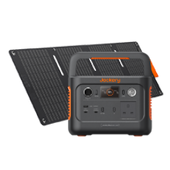
Jackery Explorer 2000 v2: A Great Way To Power Your Home And Have a Backup Plan
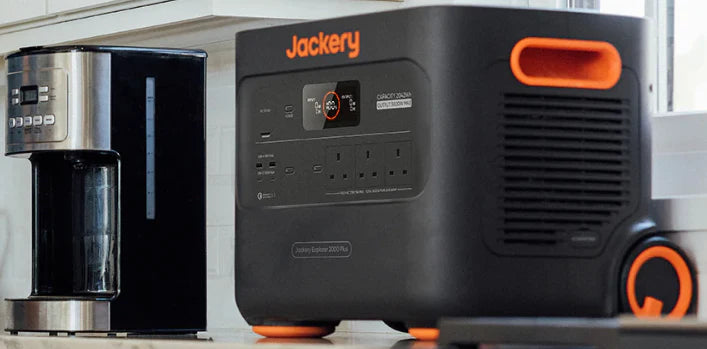
The Jackery Explorer 2000 v2 is a strong backup and outdoor power source for people who need more power. It has a big battery and a powerful continuous AC output, so it can power numerous devices at once. This makes it great for emergency power outages, DIY projects, and living in a caravan or off the grid.

When you use kVA to amps at 230V, this power station can handle loads that would normally need a modest generator. For instance, as long as the overall wattage stays within the unit's specified output, it can handle a combined load of vital appliances that draw about 7-8 kVA (around 30-35 amps at 230V). This makes the Explorer 2000 v2 a good choice for anyone who want generator-level power without the noise, emissions, or gasoline.
2042Wh Capacity, 2200W Output: The Jackery Explorer Portable Power Station 2000 v2 delivers an impressive 2042Wh capacity and 2200W output, capable of powering most of your household appliances. It also features 2 AC outlets, 1 USB-A 18W, and 2 USB-C ports (100W + 30W), allowing you to charge multiple devices like phones and laptops simultaneously.
Travel-Ready for Your Next Adventure: Introducing the world's first 2kWh LiFePO4 power station with advanced EV-grade CTB (Cell to Body) Structure technology⁵, designed to be lighter and more compact at just 38.6 lbs — about the weight of a suitcase. With a foldable handle for easy carrying, it's the perfect power solution for road trips, camping, and off-grid living.
Fast Charging in Less 1 Hour: With Emergency Super Charge Mode, easily activated via the Smart App, the power station charges from 0% to 80% in just 52 minutes—perfect for when you need power in a hurry. Even in regular AC charging mode, a full charge takes only 103 minutes.
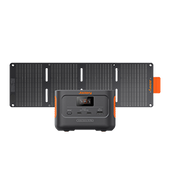
Jackery Explorer 1000 v2: Small And Powerful Power on the Go
The Jackery Explorer 1000 v2 is intended to be portable and efficient for lighter-duty tasks. It works well to power things like computers, TVs, CPAP machines, lights, and small kitchen appliances. When you change kVA to amps, a load of 2-3 kVA is around 9-13 amps at 230V, which is well within the range of this model.
This makes the Explorer 1000 v2 perfect for camping, working from home, setting up a garden office, or having a backup power source at home for a short time. It provides modest but steady power without the hassle of installing a generator.

1500W Output Power for Your Essentials: The Explorer 1000 v2 Portable Power Station offers a remarkable 1500W output, 50% higher than previous generations, effortlessly powering high-demand essentials like refrigerators, kettles, and portable air conditioners. Featuring USB-A/C ports and up to 100W dual PD charging, it's capable of keeping multiple devices (phone, laptop) charged simultaneously, making it the ultimate companion for all your power needs.
Ultra-Fast One-Hour Charging: The Emergency Charge Mode, enabled through the app, allows the Explorer 1000 v2 Portable Power Station to be fully charged in less than an hour, delivering crucial power backup when your battery runs low. Additionally, charging from 0% to 100% in just two hours using an AC wall outlet helps extend battery life.
Whisper Quiet Operation under 22dB: Immerse yourself in tranquility with its whisper-quiet operation, keeping noise levels under 22dB while powering your devices. Whether you're enjoying a camping trip, working, or simply relaxing, this power station ensures you remain undisturbed, allowing you to focus solely on what matters most.
Why kVA to Amps Matters When Choosing a Power Station
When you change kVA to amps, it doesn't matter if you choose a high-capacity model like the Explorer 2000 v2 or a smaller one like the Explorer 1000 v2.
The power station's safe working limits are still within reach of your appliances.
You don't overload plugs and inverters.
You get the most out of your battery and runtime.
You follow UK voltage standards (230V single-phase).
You may be sure that you are choosing the right portable power station for your needs by figuring out your total load in kVA and then translating it to amps.
FAQs
The following are frequently asked questions about kVA to amps.
1. What is 1 kVA in amps?
For a normal UK single-phase 230V supply, 1 kVA is around 4.3 amps. This means that a 1 kVA gadget will require little over four amps when plugged into a normal home outlet. When you utilise a three-phase system, the load is spread out over three lines, so the current is reduced. For example, 1 kVA on a 400V supply works out to about 1.4 amps per phase.
2. How many kVA in 60 amps?
A conventional UK single-phase supply can handle roughly 13.8 kVA with 60 amps. This is what you would expect from a small business installation or a home supply that is quite busy. In a three-phase system, the same 60 amps seems like a significantly greater apparent power, about 41.6 kVA, because three wires are sending electricity instead of just one.
3. How many kVA is 100A three-phase?
A 400V, 100-amp three-phase supply is around 69 kVA. This amount of power is frequent in big commercial buildings, workshops, and small factories when many machines or powerful tools are running at once.
4. How many amps is a 2500 kVA transformer?
A 2,500 kVA transformer that powers a normal 400V three-phase system can send around 3,600 amps per phase. This type of transformer is utilised in big commercial buildings, data centres, and big industrial locations where very high electrical loads are always needed.
5. How many amps is a 25 kVA good for?
A 25 kVA unit can deliver slightly under 110 amps on a single-phase 230V supply. This is enough to operate numerous tools or appliances that need a lot of power at the same time. With a three-phase system, the same 25 kVA rating gives around 36 amps per phase. This makes it good for small workshops, light industrial gear, or commercial loads that are spread out evenly.
Final Thoughts
Converting kVA to amps is not only a technical task; it's also a useful technique to keep your electrical system safe and make smart choices about how much power you use. Understanding this conversion can help you make sure your gadgets perform securely and efficiently, while you're setting up a workshop, managing commercial equipment, or picking a portable power source.
For example, the Jackery Portable Power Stations illustrate how this information may be used in real life, from home backup to travelling without electricity. You lower risk, increase dependability, and get the most out of your power tools by utilising correct conversions and realistic load predictions.