













![[Over £1200 Tier Gift] Bluetooth Speaker with Phone Stand - shipped Separately](http://uk.jackery.com/cdn/shop/files/Portable_Bluetooth_Speaker_with_Phone_Stand_2.png?v=1781595581&width=170)















Solar panels for boats are changing the way sailors, yacht owners, and liveaboards use electricity at sea. Marine solar panels are designed to absorb sunlight and convert it into electricity, allowing you to operate appliances, charge batteries, and lessen your need for fuel. Whether you have a little boat or a huge yacht, solar energy reduces emissions, increases time on the water, and reduces generator noise.
Boat owners may customise installations to meet their specific requirements by choosing from flexible, rigid, or amorphous panels. This guide covers everything from the types and benefits to installation, pricing, and efficiency factors.
|
Key Takeaways: |
|
What Are Solar Panels for Boats?
Solar panels for boats, also known as marine solar panels, are very similar to solar PV (photovoltaic) panels that you would put on your home's roof. Both kinds of panels are long-lasting, waterproof devices made of crystalline silicon. They capture sunlight's energy and convert it into electricity to power your equipment.
What Are Marine Solar Panels Used For?
Marine solar panels fuel your boat's batteries with pure solar energy. Whereas you would ordinarily have to use fuel to keep the electricity on, marine solar panels obliterate this need.
If you own a yacht, you may remain out at sea for extended periods of time by using marine solar panels to fulfil all of your electrical needs. You can also power your boat's engine with solar panels, though this is often only possible on smaller boats. Larger boats sometimes demand more electricity than solar panels can currently provide.
As a result, most individuals purchase marine solar panels to power their appliances. To keep an electric motor charged, some boats use solar panels and a petrol- or diesel-powered generator.
How Do Solar Panels for Boats Work?
Solar panels on boats operate similarly to solar panels on land. The first step is to place your solar panel in the sun, where it will convert solar energy into electricity, which is then transported via cables to your solar battery and stored until required.
Solar panels are often used to charge batteries or banks rather than powering electrical equipment directly. This permits solar energy to be retained rather than released immediately, enabling you to use the power produced by the panels long after the sun has set.
Although solar panels might be costly initially, they soon pay for themselves over time by providing a free source of power once installed. Furthermore, since solar panels are modular, you can expand your setup over time, enabling you to start small and add additional panels to your solar array as your power needs (and/or finances) grow.

Why Should I Install Solar Panels for My Boat?
Even tiny boats with outboard engines need some electricity, and solar energy is one of the most environmentally friendly options. At a time when our rivers and seas are suffering due to fast climate change and acidification caused by excessive levels of CO2, switching to solar energy means you'll be doing your part to protect the waterways you care about.
Solar energy is also financially and practically advantageous for boat owners. After you've paid for your panels, which will last at least 25 years, solar power is free. Here are a few of the things it allows you to do:
- Charge your boat's battery while reducing the strain on the battery bank. Your solar panels will charge the battery while you are away, so it seldom has to be recharged and should never be entirely discharged.
- Power your boat without carrying diesel or stopping to refill. If your yacht is too large to be powered entirely by solar energy, consider combining a solar-powered electric engine with a gasoline- or diesel-powered generator.
- Reduce noise on your boat by a dramatic amount.
- Power your boat over the summer without warming the cabin.
- Power every equipment on your boat, including phone chargers and the whole houseboat kitchen.
- Reduce carbon dioxide emissions and other pollutants while reducing your boat's weight.
Things To Consider Before Buying Marine Solar Panels
Buying solar panels for boats requires research and planning, factoring in power requirements, budget, and setup. Learning may take time, but the knowledge is easily accessible. Here are essential considerations when purchasing solar panels:

Power Output
Begin by determining the required energy quantity. Make a list of all the electrical systems, appliances, and other devices you wish to power with solar energy, such as your cooler, fridge, phone, and Kindle. Calculate the energy required for each device by converting the current to amperes and multiplying by the daily use time.
Add the ampere-hour totals for all electronics to get the total energy usage in ampere-hours. Calculate the average sunshine hours per day at your vessel's location. Then divide the daily energy usage (in ampere-hours) by the average number of solar hours to get the daily energy needs in watts.
Available Installation Space
Boats come in a variety of sizes and configurations, requiring measurements of available dimensions and panel installation locations. Considerations for good fit, secure attachment, sun exposure, and aesthetic appeal should lead your decision.
Divide the required solar panel capacity by the individual panel wattage to determine the number of panels needed, ensuring you stay within the allowed dimensions and weight restrictions.
Waterproofs and Durability
Before purchase, make sure the panels are waterproof and have an Ingress Protection (IP) rating of IP67 or higher. This protects the panels from water and dust: encapsulation layers and polymers such as ethylene vinyl acetate or tetrafluoroethylene keep solar cells and electronics dry. Select suitable sealing mechanisms to prevent water entry when mounting equipment.
Cost
Create a solar panel budget that accounts for the trade-off between cost and quality. Cheaper panels may save money in the short term, but their efficiency and durability may suffer in the long run. Compare costs, system components, warranties, and services provided. Consider the return on investment, including potential long-term savings from batteries or shore power.
The Brand's Reputation
Look for positive brand evaluations and customer satisfaction as evidence of a reputable buy. Ensure guaranteed satisfaction, acknowledging that, although sturdy, solar panels are not impregnable.
Types of Solar Panels
Choose a panel type depending on your local demands. Rigid panels are sturdy and efficient, but they are heavy, while flexible and semi-flexible panels provide variety. Portable panels are convenient and suitable for tiny electrical equipment.
Accessories
Consider other components such as charge controllers, inverters, mounting brackets, hardware, and batteries. Certain brands may need special accessories. Solar kits make the procedure easier.
Installation
Determine the best installation method based on your system's size. Hiring an installer may save time, while a DIY option saves money but requires more research and execution.

How Much Solar Do I Need For A Boat?
If you're considering putting solar panels on your boat, the first step is to determine the panel size you'll need. To do so, you'll need to understand how much energy your boat consumes. This may seem frightening, but it isn't as complicated as it appears.
To begin, you must determine how many watt-hours each gadget on your boat consumes. For example, if you want your solar panel to charge your fridge, lights, and laptop, you must first determine how many watt-hours each device requires.
Most appliances specify their energy consumption either on the package or the socket, but the difficult part is determining how long the item will operate. For example, how long does your refrigerator run? How frequently should you charge your laptop? What occurs during nighttime?
Example
A liveaboard catamaran owner wants to use solar electricity to run their onboard refrigerator. The fridge is a conventional marine 12V setup that draws around four amps. It will be operational for around 12 hours each day.
To determine wattage, multiply the amps by the voltage and the hours. So, 4A x 12V x 12 hours is 576 Wh.
You'll then need to account for discharge, so add around 10-20%. In this case, you'd need at least a 700 Wh solar panel to power the fridge.
If you wish to add additional equipment and become more self-sufficient, repeat this calculation for everything you want the solar panel to power, then add 576 Wh to get your vessel's total energy needs. Don't forget to add 20%.
How Many Solar Panels Do You Need For Your Boat?
The usual rule of thumb is 100 watts per 10 feet of boat; however, this can vary depending on how much electricity you want to utilise.
This functional table will give you a general estimate of how much electricity popular boat appliances consume:
|
Appliance |
Power consumption per hour |
Average daily usage |
|
Fridge |
100 |
2,400 |
|
LED light |
12 |
96 |
|
Fan |
75 |
600 |
|
Navigation panel |
2 |
16 |
|
LCD television |
60 |
480 |
That works out to 249 watts per hour, or 3,592 watts per day. Thus, in this situation, a 400-watt system would be required to keep everything functioning correctly.
Types of Solar Panels for Boats
Although solar panels for boats have advanced significantly in recent years, the three basic types of panels retain their construction. A solar-powered boat may have monocrystalline, polycrystalline, or amorphous panels.
Monocrystalline Solar Panels
Monocrystalline solar panels are the original and most widely used form of panel. As the name implies, they are formed from single, thin slices of crystal silicone, which are then placed in a sturdy aluminium frame coated with tempered, shatterproof glass. This allows them to withstand harsh conditions (but they may fracture or shatter under excessive use).
Monocrystalline solar panels have a conversion efficiency of roughly 17%, making them the most efficient and providing the most electricity production per area. The disadvantage is that they are generally the most costly and need a permanent home in an area where they will not be trampled.
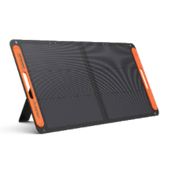
The Jackery Solar Panels, which utilise monocrystalline solar cells, such as the SolarSaga 100W and SolarSaga 200W, are designed for portability, high efficiency, and outdoor durability.
Polycrystalline Solar Panels
Polycrystalline solar panels, like monocrystalline panels, are made by melting crystalline silicon pieces into a single piece. This typically results in a broken glass look. While their energy conversion is significantly lower (about 14%), they are less costly than their single-cell counterparts.
Amorphous Solar Panels
Amorphous solar panels are the least efficient choice, although they are improving as technology advances. They are constructed by sandwiching a tiny slice of active silicon on a solid or flexible backing between rubber and polymer coverings, giving them enough durability to be walked on. Amorphous solar panels may sometimes be folded up for storage when not in use.
While crystalline solar panels can stop an entire module with the mere shadow of a rope, amorphous solar panels have an advantage if shade is a problem. They have clever "bypass" diodes that turn off shaded cells and create new pathways around them, reducing energy loss in the shade. Some monocrystalline solar panels also have bypass diodes, but they are more expensive.

Flexible or Solid
When considering the many types of solar panels for your boat, you should also evaluate whether a flexible or a solid panel is preferable. Yacht solar panels are typically well constructed and fitted to a solar arch. Mine is mounted above the dinghy davits, high enough to avoid shadows from the mast and rigging.
Boat solar panels, on the other hand, may need to be stepped on or be flexible enough to accommodate the roof's bends. Fans of YouTube sailors La Vagabond may note that they have flexible solar panels on their trimaran that can be placed in a locker in heavy winds or when not in use, providing a vital supplement to their other, more permanent, ecologically friendly energy sources.
Flexible
As the name implies, flexible marine solar panels can bend and flex, making them ideal for fitting around a boat's curves and taking up less space than a solid, installed system. Many flexible solar panels are sturdy enough to be stomped on. However, if you're employing solar panels in a sea setting, make sure they have a non-slip coating!
Flexible solar panels are amorphous, thus they have a lower efficiency rating of roughly 7-13% compared to the 18-22% possible with more current, monocrystalline panels, which means you'll need to cover a bigger surface area to get the same power output as a non-flexible panel.
Flexible panels are also the lightest option, making them easy to transport if you're not always on board and don't want to keep them out all day.
Solid
Solid marine solar panels are likely more frequent, particularly on yachts and other sailing vessels. Although their rigid construction requires a permanent frame and makes them larger than amorphous panels, they are also more efficient, allowing you to receive more power from a smaller panel.
Mounting them correctly may also result in them taking up less usable space, since you can place them above head height in otherwise 'wasted' space. Not only does this help reduce deck clutter, but a higher placement may also help avoid shadowing, which can significantly reduce the power output of a mono- or polycrystalline solar panel.
Alternative Boat Solar Power Source: Jackery Solar Generator
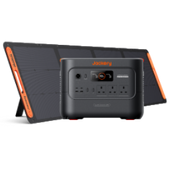
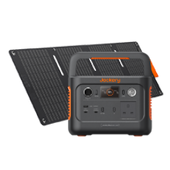
The Jackery Solar Generator (Portable Power Station paired with Jackery Solar Panels) is a popular choice for UK boaters—especially continuous cruisers or those with limited mooring access—due to its specific benefits tailored to the challenges of off-grid and boat living.
UK canal regulations strictly limit the running of noisy generators (often banned between 8 PM and 8 AM). Jackery units are completely silent, allowing you to run lights, charge devices, and power essentials through the night without disturbing your neighbours or breaching mooring rules. Unlike petrol or diesel portable generators, a Jackery system produces zero fumes or carbon monoxide (CO), making it safe to use and charge inside the boat, which is crucial in a small, enclosed space.
You don't need complicated wiring, separate inverter installation, or electrical expertise. The unit consists of a self-contained battery, a pure-sine-wave inverter, and a charge controller. You charge it up and plug in your standard UK appliances.
Jackery Solar Generator 3000 v2
The Jackery Solar Generator 3000 v2 (which combines the Jackery Explorer 3000 v2 power station with the SolarSaga 200W solar panel) is a substantial power station that addresses the limitations of power generation and storage for a canal boat or narrowboat in the UK.

High Power Output for "Home" Appliances: The most significant power challenge on a canal boat is running standard 240V AC appliances—especially those with a high momentary draw. The 3000 v2 provides substantial continuous power (3600W), sufficient to run high-draw UK appliances that would typically trip a smaller inverter or severely drain the boat's leisure batteries. The 7200W surge capacity handles the initial spike (inrush current) that appliances like microwaves, pumps, and refrigerators require when they first switch on, ensuring they start reliably.
3072Wh High Capacity: This large capacity lets you run essential items for an extended period without recharging. It can power a low-draw marine fridge (around 60W) for approximately 21 hours or run LED cabin lights for over 260 hours.
High Solar Input (1000W Max): The 3000 v2 accepts up to 1000W of solar input. This high rate is crucial for quickly generating power, particularly during the short, often cloudy daylight hours in the UK. With enough panels, you can recharge the entire unit in as little as 3.5 hours of optimal sunlight.
Fast AC Charging (AC+DC (54V) Charging): If you stop at a marina or hook up to shore power, the unit can recharge completely from a wall outlet in a remarkable 1.4 hours. This means minimal time spent tethered to the shore.
Jackery Solar Generator 2000 v2
The Jackery Solar Generator 2000 v2 (which combines the Jackery Explorer 2000 v2 power station with SolarSaga 200W solar panel) is a compelling option for a canal boat, particularly for off-grid power needs, due to its balance of capacity, portability, and key features. With a 2042 Watt-hour (Wh) capacity, it can run essential boat appliances for extended periods.

Space-Saving Design: Canal boats and narrowboats are designed to use space efficiently. The Explorer 2000 v2 is 40% smaller and 34% lighter than its predecessor, making it significantly easier to store, move around a tight cabin, and tuck away when not in use. It is described as being about the size of a basketball.
Portable Solar Panels (Solar Generator Bundle): The bundle includes foldable, high-efficiency solar panels (such as the SolarSaga 200W) that are easy to deploy on the boat's roof when moored or cruising, and then pack away securely when not needed or in adverse weather conditions.
Whisper-Quiet Operation: Noise is a significant concern on a canal, affecting both your living space and your neighbours' on the water. The Jackery operates at a low decibel level (under 30dB in quiet charging mode), eliminating the noise and toxic fumes associated with traditional diesel or gasoline generators.
LiFePO4 Battery (LFP): The unit utilises a Lithium Iron Phosphate (LiFePO4) battery, which provides enhanced safety, thermal stability, and a significantly longer lifespan (up to 4000 cycles to 70%+ capacity, translating to an estimated lifespan of over 10 years). This is ideal for a long-term, mobile living setup.
Installing Solar Panels on Boats
When installing solar panels on boats, several factors should be considered. One of the most significant challenges is a lack of room. Based on this, solar panels have been designed to be spaced apart and walkable, making the most of the available area. Some panels have been designed to hang from the mast, making the most use of available space. On larger vessels with more space, glass-fronted solar panels may be installed, which provide the most electricity for the least cost but cannot be walked on.
Installation Stages:
Installing solar panels on boats, like any other solar installation, is separated into various stages:
Step 1: The first part of the procedure is an energy evaluation of the boat, which determines how much electricity the boat uses daily.
Step 2: Using this information, we can determine how much electricity the solar panels should generate and, hence, how huge the panels should be.
Step 3: Finally, decide which sorts of panels to install, whether glass-fronted, polycarbonate, or totally flexible.
Where Should I Put My Boat Solar Panels?
Boat solar panels should be positioned where they receive the most sunlight. Your marine solar panels mustn't interfere with the vessel's operation or the crew's mobility.
Flexible solar panels are generally robust enough to stand on, but if you plan to do so, make sure the solar panel has a non-slip coating and that any connections cannot be knocked out or tripped over.
Solid solar panels are at a disadvantage, but it is worth considering installing them on a movable base. Although this requires more work, it allows you to actively rotate the solar panel throughout the day to ensure it receives as much sunlight as possible, which can then be converted into electricity for your electric boat.

How Much Do Marine Solar Panels Cost?
Prices begin at £70 for the smallest panels, which are usually 30 watts.
You should expect to spend several hundred pounds for panels with 100 watts or more, so if you live on your boat and consume a lot of power, you'll be looking at paying between £500 and £1,000, depending on how many panels you need.
Some manufacturers' pricing includes everything you need, including the wires and regulator; otherwise, you must purchase them individually.
You'll also need to decide whether to install the panels yourself; you can, but we suggest hiring a trained installer.
A 200-watt system will cost £600 or more to sell and install, while a 400-watt system would cost £1,050 including the solar controller.
If you live on your boat or use it often, you should repay your investment within a year.
Do Solar Panels on Boats Lose Efficiency?
When manufacturers quote wattage for their solar panels, customers should keep in mind that this is the predicted output under test conditions and may not reflect what they get in the real world. Solar panel testing is typically performed at 1,000W/m2 at a constant temperature of 25°C.
However, in the real world, we know that temperatures change, and as the sun moves across the sky during the day, the amount of solar energy reaching your panels varies, affecting the efficiency of your boat's solar panels.
Furthermore, any shadowing or dispersion from dust, salt, haze, or clouds may limit the amount of solar radiation that your panels can capture. Even if your boat's solar panels have bypass diodes, any shadow covering even a portion of the panels reduces the energy they can generate, so keep them clean and free of obstructions.
Believe it or not, both latitude and temperature can affect the effectiveness of your solar panels. While you might think that high temperatures are better for your solar panels, heat reduces their output by about 5% for every 10°C rise in temperature. So, you could obtain a greater production in colder northern latitudes than at the equator.
FAQs
The following are the frequently asked questions about solar panels for boats:
1. Which is the greatest sort of solar panel for a boat?
Rigid solar panels are mounted on a non-flexible frame. If you have enough flat area on your boat's roof or deck, solid solar panels may be the most durable alternative. They are handy for yachts and other maritime boats that may encounter turbulent weather.
2. What is the 33% rule in solar panels?
For a conventional solar system without a battery, you may oversize your solar panels by up to 33% of the inverter's capacity. If you have a 10kW inverter, you may install a maximum of 13kW solar panels. When you add a DC-coupled battery, the regulations alter.
3. What will a 4000-watt solar panel run?
A 4000-watt solar generator can power a variety of outdoor cooking appliances, including electric grills, deep fryers, and slow cookers. These appliances are often utilised at events, and the option to power them with clean solar energy adds a layer of sustainability to your event.
4. What can a 5000-watt solar panel power?
These devices generate enough energy to power an ordinary home just as efficiently as grid electricity. A 5kW solar system can power a washing machine, air conditioner, refrigerator, water heater, oven, and television. If you have these appliances in your house, a 5kW solar system will suffice.
Final Thoughts
Boat solar panels provide a sustainable, practical, and cost-effective energy alternative for boat owners. While the initial cost may seem costly, the long-term savings and freedom from continuous refuelling make them an excellent investment. Solar panels not only reduce carbon footprints but also improve onboard comfort by quietly powering appliances, lights, and gadgets.
You may enjoy efficient, dependable solar energy at sea by carefully calculating power requirements, selecting the appropriate panels, and organising the installation. For anyone seeking independence, sustainability, and efficiency, solar panels for boats are among the finest contemporary innovations in maritime life.


