




















![[Over £1200 Tier Gift] Bluetooth Speaker with Phone Stand - shipped Separately](http://uk.jackery.com/cdn/shop/files/Portable_Bluetooth_Speaker_with_Phone_Stand_2.png?v=1781595581&width=170)


















A 700W solar panel may appear to offer a clear advantage over a 500W model, but the headline figure does not tell the whole story. Many 700W panels are built for utility-scale or large commercial projects, so they can be considerably larger and heavier than residential modules. Once output is divided by surface area, the two panels may deliver a similar number of watts per square metre. This is why the biggest solar panel wattage does not automatically identify the best option for a UK rooftop.
Three questions matter when assessing today’s high-output panels.
What is the highest wattage currently available as a commercial product rather than a laboratory record?
How much of that technology is realistically suitable for a British home with limited roof space, chimneys, roof windows and structural constraints?
And should buyers prioritise watts per panel, module efficiency or power density?
This guide examines wattage ranges across residential, commercial and utility-scale panels instead of presenting an unrelated multi-brand league table.
|
Key Takeaways: |
|
What Does Solar Panel Wattage Actually Mean?
Solar panel wattage describes the module’s rated direct-current output. It is normally expressed in watts (W) or watts-peak (Wp). A 500Wp panel can produce up to 500W under Standard Test Conditions: solar irradiance of 1,000W/m², a cell temperature of 25°C and a defined light spectrum. This laboratory rating allows consistent product comparison, but it is not a promise of continuous output on a roof.
The units describe different quantities:
- W or Wp: instantaneous panel power under specified test conditions.
- Wh: energy produced or consumed when one watt operates for one hour.
- kWh: 1,000Wh; the unit used on electricity bills.
- kWp: the combined rated capacity of a solar array.
For example:
8 x 500W = 4,000Wp = 4kWp
This creates a 4kWp array—not 4kWh of guaranteed daily generation. Its actual energy yield depends on how much power it produces over time.
A 500W panel rarely remains at exactly 500W throughout the day. Output rises and falls with irradiance, cloud cover, shading, roof direction and angle. High cell temperatures usually reduce power, while cables and the inverter introduce further conversion losses. Brief peaks around or even above the rating may occur in favourable conditions, but they should not be treated as normal continuous output.
For a bifacial module, the nameplate rating commonly describes front-side output under STC. Rear-side generation depends on ground reflectivity, mounting height and shading, so a fixed bifacial gain should not simply be added to the stated solar panel wattage.

What Is the Biggest Solar Panel Wattage Currently Available?
As of August 2026, the highest commercially listed panel identified in current UK reporting is rated at 795W. However, that figure should not be confused with the wattage normally offered for a British home. The module is approximately 3.2m², whereas residential panels are generally smaller and easier to position around chimneys, roof windows and irregular roof edges. Its presence on a datasheet also does not guarantee stock, certification acceptance or installer access in every UK region.
The wattage landscape can be divided into five broad categories:
|
Panel category |
Indicative individual-panel output |
Typical context |
UK-home suitability |
|
Compact or portable |
50–200W |
Camping, vans and small off-grid loads |
Not a conventional rooftop substitute |
|
Conventional residential |
Approximately 350–500W |
Pitched and flat domestic roofs |
Usually the most relevant category |
|
Large residential or commercial |
Approximately 500–600W |
Large roofs and commercial buildings |
Possible if dimensions and loads work |
|
Utility-scale |
Approximately 600–800W |
Solar farms and large industrial roofs |
Often too large or heavy for domestic layouts |
|
Experimental or announced technology |
800W+ in selected cases |
Laboratories, demonstrations or future products |
Not necessarily commercially obtainable |
The biggest wattage solar panel should therefore be identified by both its rating and its status. AIKO publishes a datasheet covering modules up to 795W, with the top version rated at 24.8% efficiency. Current reporting identifies it as the highest-output commercial model, although regional availability must still be checked.
Laboratory technology has already moved further. Trina Solar announced an independently tested 829W perovskite-silicon tandem module in 2025. This was a research achievement, not proof that an 829W rooftop product could be ordered for a UK installation.
For UK households, the most relevant highest wattage solar panel is therefore the highest-output module that physically fits the roof, is electrically compatible and can be supplied with suitable installation documentation—not simply the largest published number.

Why Do Some Solar Panels Reach 600W, 700W or More?
A panel can achieve a higher power rating in two ways: by collecting sunlight over a larger surface or by converting more of the available sunlight into electricity per square metre. Many products combine both approaches, but size remains a major reason why utility-scale modules reach 600W or 700W.
Larger silicon wafers allow manufacturers to build bigger cells, while longer modules can contain more cells. Half-cut and rectangular cells make it easier to use the available panel area efficiently and can also reduce electrical resistance. As a result, a 700W solar panel may contain substantially more active material than a 400–500W residential module.
Several cell and module technologies can increase output further:
- N-type TOPCon cells reduce energy losses at the cell’s electrical contacts and have become common in high-output modules.
- Back-contact designs move electrical conductors away from the light-facing surface, reducing front-side shading.
- Heterojunction cells combine crystalline silicon with thin amorphous-silicon layers to improve efficiency and temperature performance.
- Multi-busbar layouts use numerous fine conductors to collect current more effectively.
- High-density layouts reduce gaps between cells, increasing the active area within the frame.
- Bifacial glass-glass panels can generate additional electricity from light reaching the rear surface, although this variable gain is normally assessed separately from the front-side STC rating.
- Silicon-perovskite tandem cells stack materials that absorb different parts of the solar spectrum. They have produced high laboratory efficiencies but are not yet a standard UK rooftop choice.
These developments help explain why the highest wattage solar panel ratings have increased. However, a large utility module can exceed 700W mainly because it covers around 3m², not because it produces dramatically more power from every square metre. For a restricted British roof, efficiency and power density may therefore matter more than the nameplate wattage alone.

Panel Wattage, Efficiency and W/m²: Which Number Matters Most?
No single figure is sufficient for every comparison. Watts per panel describe the output of one module, while solar panel efficiency and power density show how effectively that module uses its available area. This distinction matters because a 700W panel can produce more electricity than a 500W panel yet occupy a proportionately larger space.
Power density is calculated as:
-
Power density = rated panel output in W/total panel area in m²
The following examples demonstrate why the headline rating can be misleading:
|
Example panel |
Rated power |
Approximate area |
Approximate power density |
|
Panel A |
450W |
2.0m² |
225W/m² |
|
Panel B |
500W |
2.2m² |
227W/m² |
|
Panel C |
700W |
3.1m² |
226W/m² |
These are illustrative figures, not test results for specific products. Panel B has a lower nameplate rating than Panel C but delivers slightly more watts per square metre. If both could cover the same usable roof area without gaps or obstructions, their total installed capacities could therefore be similar.
Each metric answers a different buying question:
- Watts per panel matter when the number of mounting positions, clamps, optimisers or electrical connections is restricted. Larger modules may also reduce the number of panels required for a target array capacity.
- Efficiency shows the percentage of incident solar energy converted into electricity under test conditions. It is particularly relevant when comparing panels of different sizes.
- W/m² gives a direct measure of power density and is useful for a small or obstructed UK roof.
- £/W helps compare upfront value, but it should be calculated from comparable installed quotations rather than panel prices alone.
- Expected kWh per year is the most useful measure for complete proposals because it incorporates array size, location, orientation, pitch, shading and system losses.
Roof layout can still overturn a simple W/m² comparison. A physically smaller panel may fit around a chimney or roof window more effectively, allowing a higher total capacity. Buyers should therefore compare complete roof designs and annual generation estimates, not individual specifications in isolation.
Are 500W and 700W solar panels suitable for UK homes?
Both wattage classes exist, but their suitability depends on more than rated output. A panel must fit the usable roof, remain within structural limits and match the inverter’s electrical operating range. For many households, a manageable 500W module will be easier to accommodate than a larger 700W utility panel.
Is there a 500W solar panel?
Yes. The 500W solar panel is commercially available, and some models are designed for residential or mixed residential-commercial use. It can reduce the number of modules needed for a target array capacity: eight 500W panels, for example, provide 4kWp.
However, two 500W modules can have different dimensions, weights, voltages and currents. Suitability must therefore be based on the complete datasheet and proposed roof layout rather than the wattage label alone.
Is there a 700W solar panel?
Yes. 700W solar panels are available, but many are intended primarily for solar farms, industrial buildings and large commercial roofs. They commonly have more cells, a larger surface area and a weight approaching or exceeding 35–40kg.
Their size can make them difficult to carry safely on scaffolding, manoeuvre across a pitched roof and position around obstructions. A 700W rating therefore does not automatically make the module a better residential choice.
What must be checked before choosing a high-wattage panel?
A residential assessment should cover:
- Usable rectangular roof area and required edge clearances
- Chimneys, dormers, roof windows, vents and shading
- Exact panel dimensions, not only wattage
- Module weight and manual-handling requirements
- Rafter spacing, roof covering and structural condition
- Site-specific wind and snow loads
- Permitted clamping zones in the manufacturer’s installation manual
- Scaffolding, lifting arrangements and installer access
- Appearance and proportions on a smaller pitched roof
- Suitable product certification, MCS requirements and compatibility with the mounting system, inverter and electrical design.
UK retailers already list modules above 600W, including a 640W bifacial commercial panel. However, being available to buy does not establish that a product is appropriate for a particular house.

How Many High-Wattage Panels Will Fit, and How Much Could They Generate?
Start with the usable roof area rather than the total roof dimensions. Chimneys, roof windows, vents, shaded sections, required clearances and unsuitable structural areas can all reduce the space available for panels.
The array’s rated capacity is calculated as:
Number of panels x panel wattage = array capacity
For example:
- 8 x 500W = 4,000Wp = 4.0kWp
- 6 x 700W = 4,200Wp = 4.2kWp
The 700W option uses fewer modules, but this does not mean it requires less roof space. Using illustrative panel areas from the earlier comparison:
|
Layout |
Panel count |
Total capacity |
Approximate module area |
|
500W panels |
8 |
4.0kWp |
17.6m² |
|
700W panels |
6 |
4.2kWp |
18.6m² |
These figures cover the modules only. They exclude gaps, roof-edge clearances and space lost around obstructions. Exact product dimensions and a scaled roof plan are required before confirming how many panels will fit.
Indicative annual electricity generation can be estimated with:
Annual generation = array capacity x location-specific annual yield
- If an illustrative site yield were 900kWh per kWp per year, the calculation would be:
- 4.0kWp × 900 = approximately 3,600kWh/year
- 4.2kWp × 900 = approximately 3,780kWh/year
These are calculation examples, not production forecasts. Actual yield depends on the postcode, roof direction, pitch, shading, local weather, inverter design and system losses. UK households should use PVGIS or request an MCS-compliant generation estimate from the installer instead of multiplying panel wattage by generic daily “sun hours”.
A smaller module can sometimes fit an awkward roof more efficiently, producing a larger or less-shaded array despite its lower individual rating. The correct comparison is therefore total installed kWp and estimated annual kWh—not simply panel count.
What Can a 2,000W or 10,000W Solar System Power?
The phrases “2,000 watt solar panel” and “10,000 watt solar panel” usually refer to a complete solar array or inverter system, not one conventional domestic module. Array capacity is more accurately written as 2kWp or 10kWp because it represents the combined panel rating under Standard Test Conditions.
|
System size |
Example panel arrangement |
Potential daytime uses |
Important limitation |
|
2kWp |
4 × 500W |
Background loads, lighting, electronics and part of an appliance’s demand |
Output changes continually |
|
4kWp |
8 × 500W |
Broader household demand and appropriately timed appliance use |
High-power appliances may still require grid support |
|
10kWp |
20 × 500W |
Large-home demand, battery charging and contributions to an EV charger or heat pump |
Requires sufficient roof area and an appropriate grid-connection design |
A 10kWp array does not continuously deliver 10kW. It might approach its rated DC output under strong sunlight and favourable temperatures, but generation falls with cloud, shading, poor orientation and low winter irradiance. The inverter may also have a lower AC output rating than the panel array.
Whether the system can run a kettle, oven, heat pump or EV charger depends on the power available at that moment. For example, if the panels and inverter are supplying 3kW while the home is using 5kW, the remaining 2kW must come from the grid or a battery with sufficient charge and discharge power. Without either source, demand must be reduced.
The units should not be confused:
- kW measures instantaneous power—the rate at which electricity is being generated or consumed.
- kWh measures energy accumulated over time. A 2kW appliance operating for three hours uses 6kWh.
- kWp describes the panels’ combined rated DC capacity.
A proposed 10kW solar system in the UK should therefore be assessed using its estimated annual kWh generation, hourly household load, inverter rating, battery design and DNO connection requirements. The array’s peak rating alone cannot establish which appliances it will reliably support.
Matching High-Wattage Panels with the Jackery SolarVault 3 Pro Max
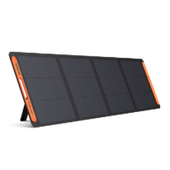
The Jackery SolarVault 3 Pro Max provides a useful example of why panel wattage must be matched to the receiving equipment. Jackery UK describes the system as suitable for common 500W-class panels, while a compatible 500W rigid bifacial module can combine residential-scale output with manageable dimensions.
A 500W bifacial glass-glass panel may have:
- 500Wp front-side rated output
- Approximately 22.6% module efficiency
- A durable double-glass construction
- Additional rear-side generation where reflected light can reach the module
The bifacial contribution varies with mounting and surface reflectivity, so it should not be treated as a guaranteed addition to the 500Wp nameplate rating.

The Jackery SolarVault 3 Pro Max has four independently controlled MPPT inputs. Each supports up to 1,000W, giving a maximum combined DC solar input of 4,000W. Its LFP battery starts at 2.52kWh and can be expanded to 15.12kWh within one tower. With compatible metering and app-based controls, the system can monitor household demand, store daytime solar surplus and release energy later.
Eight 500W panels would provide:
8 × 500W = 4,000Wp
Conceptually, two appropriately matched panels could be assigned to each of the four MPPT channels. However, this arrangement is valid only if the chosen series or parallel connection remains within every input limit. Jackery specifies 16–60V open-circuit voltage, no more than 28A short-circuit current, 1,000W per MPPT and 4,000W overall.
Temperature-adjusted voltage, connector compatibility, panel orientation and the need for parallel branch cables must also be checked. Two nominally compatible 500W panels should therefore not be connected to one channel solely because their wattages add up to 1,000W.
Backup operation is separate from ordinary grid-connected energy storage. The Pro Max can provide a 2,500W backup output with suitable installation.
UK Installation Rules and Electrical Compatibility
The biggest solar panel wattage cannot be assessed separately from the inverter and grid connection. Solar panels are rated in DC kilowatt-peak, while an inverter is rated by the AC power it can deliver. A 4kWp panel array can therefore be connected to an inverter rated below 4kW, provided the equipment permits that DC-to-AC sizing ratio.
For a single installation, the main connection routes are:
- G98: applies to fully type-tested generation equipment operating at no more than 16A per phase—approximately 3.68kW at 230V. Installation normally follows the connect-and-notify route.
- G99: generally requires DNO approval before connection where the relevant generating capacity exceeds the G98 limit.
- G100 export limitation: may be used where installed generating capacity is higher but export must be restricted to a DNO-agreed level.
SSEN separates installations up to 3.68kW per phase from those above that level. It also offers G99 fast-track routes for selected combinations of solar generation, battery storage and G100 export limitation.
The commonly quoted 3.68kW figure generally concerns AC generating capacity per phase and the applicable connection route. It is not a universal 3.68kWp ceiling on the DC panels. The DNO assessment must also include existing generation, battery inverters and any other equipment capable of exporting electricity.
Important: Do not assume that eight 500W panels are prohibited because they total 4kWp. The DNO assessment depends on the inverter, export arrangement, existing generation and connection design.
Smart Export Guarantee eligibility is also determined at system level. The installation must meet the scheme’s technical and metering requirements, and suppliers may require an MCS certificate or recognised equivalent documentation before accepting an application. Ofgem confirms that eligible solar PV installations in Great Britain can participate up to 5MW, subject to the scheme criteria.

How to Choose the Right Panel Wattage for Your Roof
The correct solar panel wattage is the one that produces the strongest complete roof design at an acceptable cost. A high individual rating has little value if the panel cannot fit around obstructions, exceeds electrical limits or reduces the number of modules that can be installed.
Use this decision sequence:
- Measure usable roof sections. Exclude chimneys, dormers, roof windows, vents, heavily shaded areas and required edge clearances.
- Test alternative layouts. Compare the exact module dimensions in both portrait and landscape orientations.
- Calculate total array capacity. Multiply the number of panels in each workable layout by their rated wattage to obtain total kWp.
- Compare area efficiency. Review module efficiency and W/m² rather than assuming that the highest watts per panel make best use of the roof.
- Check structural compatibility. Confirm module weight, roof loading, wind and snow calculations, rafter positions and permitted clamping zones.
- Verify electrical limits. Match open-circuit voltage, operating voltage and current to each inverter or MPPT input, including temperature corrections.
- Compare annual generation. Use the same postcode, orientation, pitch, shading and loss assumptions for every proposed layout.
- Review both warranties. Separate the product warranty, which covers manufacturing defects, from the performance warranty, which concerns retained output.
- Compare financial value. Calculate the installed price per watt, expected annual kWh and likely self-consumption rather than comparing module prices alone.
- Confirm connection requirements. Check the DNO route, MCS documentation, export metering and tariff eligibility for the complete system.
- Assess battery storage separately. Add capacity only if the array is expected to produce enough recurring surplus to charge it and the household can use the stored energy later.
|
Situation |
Likely priority |
|
Small, obstructed roof |
High efficiency and flexible dimensions |
|
Large, simple roof |
Installed cost per watt |
|
Limited mounting positions |
Higher wattage per panel |
|
Heavy evening consumption |
Array and battery sizing together |
|
Commercial roof or ground array |
Large-format 600–700W+ modules may be practical |
The biggest solar panel wattage should therefore be a design input, not the final selection criterion. Compare complete layouts before choosing the module.
FAQs
The following are the frequently asked questions about the biggest solar panel wattage:
What is the highest wattage on a solar panel?
As of August 2026, current UK reporting identifies a commercially listed panel rated at 795W. However, it is a large-format module of approximately 3.2m² rather than a conventional domestic panel. Laboratory technology has gone further: an independently tested silicon-perovskite tandem module reached 829W in 2025. Records and availability change, so the highest wattage solar panel should always be date-qualified.
What can a 10,000 watt solar panel power?
A single typical domestic panel is not rated at 10,000W. The phrase normally describes a 10kWp solar array. Under suitable sunlight, such a system could contribute to household appliances, a heat pump, EV charging and battery charging. It will not continuously provide 10kW; the available power depends on sunlight, inverter capacity, household demand and any battery output.
Is a higher-wattage solar panel always better?
No. A higher rating may result from a larger panel rather than better conversion of sunlight. Compare module dimensions, efficiency, W/m², weight, electrical characteristics, installed cost and expected annual generation. A smaller panel may create a better total layout on a roof interrupted by chimneys, dormers or roof windows.
Can a UK home have a 10kW solar system?
Yes, provided there is enough suitable roof or ground area and the structural, planning and electrical requirements are met. A 10kWp DC array is not automatically prohibited, but its inverter and export design will determine the DNO connection route. A single-phase installation of this scale will commonly require G99 assessment, although an approved export-limitation arrangement may affect the connection design.
Do high-wattage panels need a special inverter?
Not simply because their wattage is higher. The inverter or MPPT must accept the panel configuration’s voltage, current and total power. Check the operating-voltage range, maximum open-circuit voltage at low temperature, input-current limit, short-circuit-current limit and maximum permitted DC input. Large-format panels can have higher current, which may make some older inverters unsuitable.
How many 500W solar panels are needed for a 4kW system?
Eight:
4,000W / 500W = 8
Eight 500W modules create a 4kWp DC array. This does not mean they will continuously generate 4kW or produce 4kWh every day. The panels must also fit the roof and remain compatible with the mounting system, inverter inputs and DNO connection design.
What are the solar cell sizes?
“Cell size” normally refers to the original silicon wafer dimensions, not the overall panel. Common formats include:
- M6: approximately 166 × 166mm
- M10: approximately 182 × 182mm
- G12: approximately 210 × 210mm
- M10R and G12R: rectangular variations of larger wafer formats
Manufacturers frequently cut these cells into halves or smaller sections. A panel described as containing 108 half-cells, for example, is electrically comparable to a 54-full-cell layout. LONGi uses 182mm M10 wafers in a 108 half-cell residential-format module, while Trina Solar uses 210mm technology across several panel sizes.
What are the standard residential and commercial or utility solar panels?
There is no single universal size, but broad categories are useful:
|
Panel format |
Common modern configuration |
Approximate output |
Typical application |
|
Residential |
108, 120 or 132 half-cells |
Around 350–500W |
Houses and small roofs |
|
Commercial |
132 or 144 half-cells and other large formats |
Around 450–650W |
Warehouses and larger buildings |
|
Utility-scale |
Large 132-, 144-cell or specialised layouts |
Around 600–800W |
Solar farms and large ground arrays |
Traditional terminology describes 60-cell panels as residential and 72-cell panels as commercial. Their half-cut equivalents are commonly labelled 120-cell and 144-cell. Modern rectangular cells and alternative layouts have made these categories less rigid, so buyers should compare actual dimensions, weight and electrical specifications rather than cell count alone.
Final Thoughts
The biggest solar panel wattage now approaches 800W among commercially listed modules, while experimental designs have moved beyond that level. Many of these panels are physically intended for utility-scale projects, so their size and weight can make them unsuitable for a typical UK roof.
Before choosing a module, measure the usable roof area, compare complete portrait and landscape layouts, and calculate the W/m² of each option. Model annual generation using the property’s postcode, orientation, pitch and shading. Then check panel weight, mounting requirements, inverter voltage and current limits, DNO connection route and total installed cost.
A compatible Jackery 500W-class panel configuration with the SolarVault 3 Pro Max offers one high-output residential approach, combining up to 4,000W of DC solar input with modular battery storage.


