







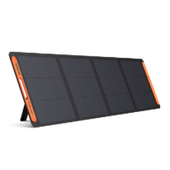
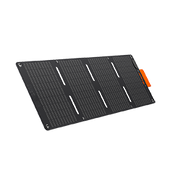
































Manchester’s cloudy reputation does not rule out productive rooftop solar. PVGIS modelling estimates that a 4.6 kWp system on a 35° west-facing roof could generate about 3,257 kWh annually, rising to 4,111 kWh with a south-facing layout.
Around 45,200 Greater Manchester homes had solar panels by September 2025—approximately 3.8% of the area’s households. Local MCS-based figures place a typical 4.95 kWp installation at about £8,629 without a battery, although roof access, shading, equipment and electrical work can change the final quote.
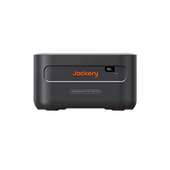
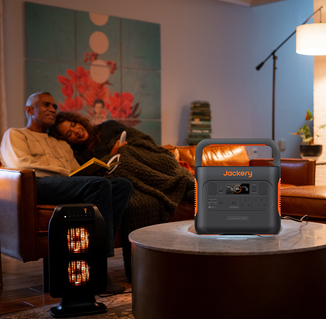
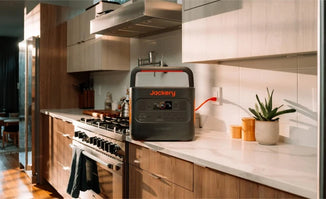
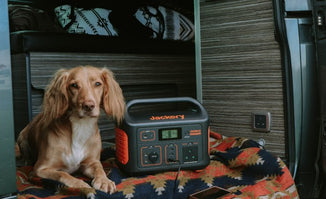
These figures make solar panels Manchester an increasingly relevant search for households seeking lower grid consumption and SEG export income. For flexible storage, the Jackery SolarVault 3 Pro Max provides a modular, plug-and-play solar energy system without permanent fixed installation, allowing generated electricity to be stored for evening use.
|
Key Takeaways: |
|
Solar Panels in Manchester: Are They Worth Considering?
Despite the city’s reputation for rain and cloud, solar panels Manchester households install do not need hot weather or uninterrupted sunshine. Photovoltaic cells convert daylight into electricity, so they continue generating on overcast days, albeit at a lower output. Production is strongly seasonal, with much more electricity generated between spring and early autumn than during winter.
A typical UK domestic system is approximately 4–5 kWp. The Energy Saving Trust estimates that a 4.5 kWp installation costs around £7,600, although Manchester quotations vary with roof access, scaffolding, equipment and electrical upgrades. PVGIS-based modelling suggests that a 4.6 kWp array in Manchester could generate about 3,257 kWh annually on a west-facing 35° roof or around 4,111 kWh if south-facing.
The financial return comes from using solar electricity instead of buying it from the grid and receiving Smart Export Guarantee payments for eligible surplus exports. Savings therefore depend on the import tariff, SEG rate and proportion of generation used at home.
When comparing solar panels Manchester UK, distinguish Manchester city from the ten-borough Greater Manchester region, as adoption and installer-coverage figures may use either boundary. Overall, solar can be worthwhile, but roof orientation, shading, household demand, system design and the complete quotation matter more than sunshine hours alone.

Is Manchester Sunny Enough for Solar Panels?
Yes. Manchester receives enough daylight for solar PV, although a system will usually generate less electricity than an equivalent unshaded array in southern England. Solar cells respond to light rather than heat, so solar panels Manchester homeowners install continue producing electricity under cloud cover. Output falls when clouds reduce the solar radiation reaching the modules, but it does not normally stop unless light levels become extremely low.
Annual sunshine hours are not the best measure of solar potential because they record periods of bright sunshine without showing the total solar energy available. Annual solar irradiation, measured in kWh/m², is more useful when estimating generation. The installer should combine local irradiation data with the array’s capacity, orientation, inclination, shading and expected system losses.
A south-facing roof generally maximises annual generation in the UK. However, an east–west layout can distribute production across more of the day: east-facing panels contribute earlier, while west-facing panels continue generating later. This may suit households with morning and evening consumption, even if total annual output is lower. Roof pitch also affects how directly sunlight reaches the modules, while chimneys, trees and neighbouring buildings can cause disproportionate losses. Inverter efficiency, cabling, dirt and normal panel degradation should also be included in the estimate. High temperatures can slightly reduce module efficiency, despite stronger summer sunlight.
|
Roof condition |
Likely effect |
What the installer should check |
|
South-facing, little shade |
Strong annual yield |
Roof area and electrical design |
|
East–west |
Broader daily production |
Panel allocation across both slopes |
|
North-facing |
Lower annual output |
Whether the projected yield justifies the cost |
|
Chimneys or nearby trees |
Variable or panel-specific losses |
Detailed shading model and mitigation options |
|
Flat roof |
Flexible orientation |
Row spacing, ballast, drainage and wind loading |
Seasonal variation is substantial: most annual generation occurs from spring to early autumn, while short days and a lower sun angle reduce winter production. Homeowners should therefore compare annual and monthly estimates rather than judging a system by one sunny or cloudy day.
Typical Solar Panel Output in Manchester
Panel wattage describes maximum rated power under standard test conditions, not the electricity a module will produce each year. To estimate solar panel output Manchester homeowners can expect, combine the array’s rated capacity with the local specific yield:
Estimated annual generation (kWh) = system capacity (kWp) × local specific yield (kWh/kWp)
For example, if a 4 kWp array achieves a modelled specific yield of 800 kWh/kWp, its estimated annual generation would be:
- 4 kWp × 800 kWh/kWp = 3,200 kWh per year
A 4 kWp system does not continuously deliver 4 kW. The figure represents its peak rated power under controlled conditions. Actual power rises and falls with daylight, cloud, shade, module temperature and the sun’s position.
Kilowatts (kW) measure power at a particular moment, whereas kilowatt-hours (kWh) measure the electricity generated or consumed over time.
The following ranges use an illustrative specific yield of approximately 700–900 kWh per installed kWp. They broadly reflect the difference between less favourable and well-oriented Manchester roofs, but must be validated with a current postcode- and roof-specific model before publication.
|
System size |
Approximate panel count* |
Indicative annual output |
Potentially suitable for |
|
2 kWp |
4–5 |
1,400–1,800 kWh |
Small roof or low-use home |
|
3 kWp |
6–8 |
2,100–2,700 kWh |
Small to medium household |
|
4 kWp |
8–10 |
2,800–3,600 kWh |
Typical family home |
|
5 kWp |
10–13 |
3,500–4,500 kWh |
Larger roof or higher demand |
|
6 kWp |
12–15 |
4,200–5,400 kWh |
High-use home, EV or heat pump |
*Panel count depends on module wattage. Ten 400 W panels and eight 500 W panels both form a 4 kWp array, but their dimensions and roof layouts differ.
Annual generation is distributed unevenly. A monthly chart for a model 4 kWp system would normally show a broad rise through spring, the highest output around late spring and summer, and a sharp reduction in winter. The exact pattern should come from the same PVGIS or MCS-compliant model used for the annual estimate.
Generation also differs from self-consumption. A home may produce 3,200 kWh annually without using all of it directly, particularly if nobody is home during sunny hours. Surplus can be exported or stored, while shortfalls are imported from the grid. Two equally sized systems may therefore deliver different output and savings because of orientation, pitch, shade, equipment efficiency and household demand timing.

How Much Do Solar Panels Cost in Manchester?
A typical domestic solar installation in Manchester is likely to cost around £5,000–£10,500, depending on system capacity, roof complexity and equipment. As a national reference point, the Energy Saving Trust estimates that an average 4.5 kWp system costs approximately £7,600. Local quotations may sit above or below this figure because labour, scaffolding and property conditions vary.
Recent MCS-based Manchester data placed a 3.15 kWp installation at about £5,491, a 4.95 kWp system at £8,629 and a 6.75 kWp array at £11,767. These figures are useful benchmarks rather than fixed prices. Homeowners should obtain at least three itemised quotations for the same capacity and design.
|
System size |
Approximate number of panels |
Indicative installed price |
Possible battery size |
|
2–3 kWp |
5–8 |
£4,500–£6,000 |
3–5 kWh |
|
4–4.5 kWp |
9–12 |
£6,500–£8,500 |
5–10 kWh |
|
5–6 kWp |
12–15 |
£8,000–£10,500 |
8–15 kWh |
|
Solar plus battery |
Varies |
Show PV and storage separately |
Based on usable surplus |
These are indicative budgeting ranges, not guaranteed solar panel costs Manchester installers will quote. Battery capacity should be based on recurring surplus generation and evening demand rather than automatically matched to array size.
The price can change because of:
- System capacity, panel efficiency and module dimensions
- Roof height, access and scaffolding requirements
- Slate, tile, flat or unusually shaped roofs
- On-roof versus integrated in-roof mounting
- String inverter, microinverter or optimiser selection
- Consumer-unit, earthing or other electrical upgrades
- Monitoring, bird protection and warranty coverage
- Battery storage, backup circuits and EV-charger integration
A low quotation may exclude scaffolding, grid paperwork or electrical upgrades, so compare the complete scope rather than the headline amount. Domestic installations currently benefit from 0% VAT when the relevant eligibility conditions are met, but quotations should state the applicable VAT treatment clearly.
How Much Do 12 Solar Panels Cost in the UK?
Twelve panels are not a standard capacity. Twelve 400 W modules create a 4.8 kWp array, whereas twelve 500 W modules create a 6 kWp system. Based on the ranges above, an installation of this scale might cost approximately £7,000–£10,500 before battery storage, subject to roof and electrical work.
Panel wattage alone is not enough to compare quotations. Higher-output modules may also be larger or heavier, affecting how many fit safely on the roof. Compare total capacity, usable roof area, inverter design, predicted annual yield, warranties and fully installed price.

Potential Savings and Payback in Manchester
The financial benefit of solar comes from three separate routes:
- Direct self-consumption: solar electricity powers appliances as it is generated, avoiding electricity imports.
- Stored self-consumption: surplus charges a battery and is used later, minus storage losses.
- Grid export: unused electricity is sold through a Smart Export Guarantee tariff.
The table below uses an illustrative 4 kWp system generating 3,200 kWh per year. It applies the Ofgem average capped electricity rate of 26.11p/kWh for 1 July–30 September 2026 and an example SEG rate of 12p/kWh. Actual Manchester tariffs, generation and consumption patterns will differ. Standing charges are excluded because solar panels do not normally remove them.
|
Scenario |
Annual generation |
Used directly or from battery |
Exported |
Annual bill reduction |
SEG income |
Total annual benefit |
|
Home empty in daytime, no battery |
3,200 kWh |
800 kWh |
2,400 kWh |
£209 |
£288 |
£497 |
|
Flexible daytime usage |
3,200 kWh |
1,440 kWh |
1,760 kWh |
£376 |
£211 |
£587 |
|
Appropriately sized battery |
3,200 kWh |
2,400 kWh |
800 kWh |
£627 |
£96 |
£723 |
The calculation is:
Annual benefit = self-consumed electricity x import rate + exported electricity x SEG rate
These scenarios show why solar panel savings Manchester households achieve cannot be reduced to one headline figure. At the assumptions above, every self-consumed kWh is worth 26.11p, compared with 12p for an exported kWh. However, a battery has an additional purchase cost and energy losses, so higher self-consumption does not automatically produce a shorter payback period.
Simple payback can be estimated as:
Payback period = net installation cost / annual financial benefit
For example, a £7,600 cash-funded system returning £587 annually has a simple payback of about 13 years. This calculation does not include tariff changes, panel degradation, maintenance or a possible inverter replacement. Most panels lose output gradually over their operating life, while an inverter may need replacing earlier than the modules.
Financed installations need a separate calculation because interest, fees and the repayment term reduce the net return. Compare the total amount repayable—not only the monthly instalment—with projected benefits under conservative tariff assumptions.
Daytime working, appliance scheduling and daytime EV charging can increase direct solar use. A heat pump may also raise consumption, although its highest demand often occurs during winter when solar production is lowest. These loads should therefore be included in an hourly or seasonal model.
Solar Panel Installers Manchester: How to Compare Companies
Choosing between solar panel installers Manchester households can use requires more than comparing star ratings. Reviews may reveal communication or workmanship problems, but they do not confirm whether a company is currently certified, financially stable or offering suitable equipment. Start with independently checkable credentials, then compare roof designs and contract terms.
The companies below serve parts of Greater Manchester, but the table is not a ranking or recommendation.
|
Installer |
Manchester coverage |
MCS status |
Consumer protection |
Workmanship warranty |
Monitoring and aftercare |
|
Sunsave |
Greater Manchester coverage stated |
MCS and Flexi-Orb certification stated |
HIES or RECC, TrustMark and associated protections stated |
20-year Sunsave Guarantee package; check full terms |
24/7 remote monitoring, repairs and replacement provisions |
|
Spectra Solar |
Wigan-based; serves Greater Manchester and a wider region |
MCS accredited |
HIES, TrustMark, NAPIT and Which? Trusted Trader listed |
Confirm the workmanship term in the quotation |
App monitoring and post-installation support stated |
|
Greentech Renewables |
Manchester, Bolton, Stockport and wider Greater Manchester |
MCS certified |
HIES, TrustMark and NAPIT listed |
Published warranty descriptions vary; obtain the precise term in writing |
App-based monitoring and ongoing support stated |
|
Other postcode-matched installers |
Confirm using the property postcode |
Check the live MCS record |
Check RECC, HIES or equivalent protection |
Request written terms and insurance-backed cover |
Define response times and responsibility for faults |
Certifications, coverage, finance products, warranty terms and customer ratings can change. Check every entry immediately before publication and before paying a deposit. Use the official MCS installer search, then confirm consumer-code membership through the relevant RECC or HIES register. The presence of hundreds of businesses in an online directory does not mean they are all locally based, currently active or equally qualified.
What to Compare in Three or More Quotations
Ask each of the Manchester solar installers to quote for the same approximate capacity, roof area and battery requirement. Otherwise, a cheaper proposal may simply contain fewer panels, a smaller battery or excluded work.
Compare:
- The installer’s live MCS status and RECC, HIES or equivalent consumer protection
- Exact panel, inverter, optimiser and battery models
- Roof-specific annual generation and monthly output estimates
- The orientation, pitch and shading assumptions used
- Scaffolding, mounting, bird protection and electrical work
- Responsibility for G98 or G99 DNO notification or approval
- Product, performance and workmanship warranty terms
- Insurance-backed guarantees and deposit protection
- Monitoring access, ownership of data and fault-response times
- Battery usable capacity, continuous power and backup capability
- Total cash price, deposit, finance APR and total amount repayable
- Cancellation rights and any survey, removal or early-repayment charges
Also check who completes the roof survey and installation. If subcontractors are involved, establish which company remains responsible for roof damage, electrical faults and warranty claims. The final quotation should identify every major component, show predicted generation and list all exclusions. This allows homeowners to compare complete systems rather than persuasive sales presentations or headline prices.

Grants, Funding and Solar Incentives in Manchester
Funding changes frequently, so solar panel grants Manchester residents find online should be checked against an official application page before any quotation is accepted. Support can be divided into currently available routes, eligibility-dependent programmes and schemes that are historical or open only during limited rounds.
Currently Available or Listed Support
The Warm Homes: Local Grant operates across Greater Manchester for eligible low-income households living in privately owned homes, including some private rented properties. It can fund combinations of insulation, low-carbon heating and renewable-energy measures. Solar PV may be included where the property assessment identifies it as suitable, but applicants should not assume that panels will automatically be funded. Income, EPC, tenure and property requirements apply. Applications should begin through the GMCA scheme page.
Manchester City Council also lists its Home Energy Loan Plan, offering eligible homeowners and some private landlords interest-free loans of up to £10,000, with administration charges. As the council page states that its scheme information was current in August 2025, applicants should confirm that funding remains available before relying on it.
Qualifying installations of solar panels and electrical storage batteries in residential accommodation currently benefit from 0% VAT until 31 March 2027. This reduces the taxable installation price but is not a cash grant. From 1 April 2027, qualifying installations are scheduled to return to the 5% reduced rate under current rules.
Eligibility-Dependent Programmes
ECO4 has been extended nationally until 31 December 2026, but the extension is intended to complete existing targets rather than create a new successor obligation. Some Greater Manchester delivery routes are no longer accepting new applications. Households should check with their energy supplier or the GMCA retrofit portal instead of assuming an installer can secure funding.
Social-housing retrofit programmes may include solar PV, insulation and heating improvements, but funding normally goes to councils or housing providers. Tenants cannot usually choose the system or claim the money directly. They should contact their landlord or housing association.
The Smart Export Guarantee pays eligible generators for measured electricity exported to the grid. It is continuing income, not help with the upfront installation cost, and requires an appropriate export meter and accepted certification.
Historical, Periodic and Commercial Routes
Solar Together ran a Greater Manchester group-buying campaign in 2019, but no current Manchester round should be advertised without a live registration page. Past discounts do not guarantee future savings.
Homeowners who do not qualify for grants can consider green loans, installer finance or mortgage-linked borrowing. Compare the APR, fees and total amount repayable with a cash purchase. Businesses may use commercial loans, leases or power-purchase agreements, subject to tax and accounting advice.
Private tenants need landlord consent; leaseholders should check roof ownership and lease terms. Landlords must also confirm who owns the system, receives SEG income and remains responsible for maintenance.

Is Your Manchester Home Suitable for Solar?
Many Manchester terraces, semidetached houses and detached homes can accommodate solar panels, but suitability should be established through a roof-specific survey. Older housing, narrow streets, shared roofs and conservation designations can make installation more complex.
Use this checklist before requesting quotations:
- Roof area: Measure the unobstructed space and compare it with the exact module dimensions. Panel wattage alone does not show how many will fit.
- Orientation and pitch: South-facing roofs usually maximise annual generation, while east–west layouts may spread production across the day. Ask for a shading assessment covering chimneys, trees, dormers and neighbouring buildings.
- Roof condition: Check the covering, battens, rafters and remaining roof life. Older slate or tile roofs may need repairs before scaffolding and panels are added.
- Ownership: Tenants require landlord permission. Leaseholders must check who owns the roof, while owners of shared or adjoining roofs should review deeds, leases and maintenance responsibilities.
- Access: Terraced streets may have limited space for scaffolding, deliveries or skips. The installer should identify whether a pavement licence or parking suspension is needed.
- Electrical system: Confirm the supply type, earthing arrangement, consumer-unit condition and available connection capacity. Include any required upgrades in the quotation.
- Metering and connectivity: Solar can generate without a smart meter or internet connection, but an export-capable meter is normally needed for SEG payments, and internet access supports remote monitoring.
- Future demand: Tell the designer about planned EV charging, battery storage or a heat pump so the array and inverter are not sized only for current consumption.
- Safe access: The layout should preserve appropriate roof edges, fire-safety considerations and routes for inspection or repair.
- Bird protection: Pigeons can nest beneath raised arrays. Mesh may be useful where there is a known problem, but it should be designed for the mounting system rather than fitted carelessly.
Rooftop solar is commonly permitted development in England when the relevant limits and conditions are met. Listed buildings, some conservation-area properties, flats, prominent installations and unusual mounting arrangements require additional checks. Homeowners should consult Manchester City Council’s planning guidance before ordering equipment.
How Many Homes in Manchester Have Solar Panels?
Around 45,200 homes across Greater Manchester had solar panels by September 2025, equivalent to approximately 3.8% of the region’s 1.18 million households. This figure refers to the ten-borough Greater Manchester area, not Manchester city alone. Published totals can also differ according to whether they count installations, properties or MCS-certified systems, so the geographic boundary and data method should always accompany the number.
Should Manchester Homes Add Battery Storage?
A battery can increase solar self-consumption by moving surplus daytime generation into the evening, but it does not automatically shorten financial payback. The strongest case is usually a home that regularly exports solar electricity and then imports electricity after sunset.
Capacity should be compared on a usable, not nominal, basis. Charge and discharge power also matter: a large battery with a low power rating may not cover several appliances operating together. Other considerations include round-trip losses, compatibility with time-of-use tariffs, warranty years and throughput limits.
Ordinary grid-connected batteries normally shut down during a power cut. Backup operation requires suitable hardware, controls and dedicated circuits. A heat pump or EV may increase the value of storage, but only if the battery has enough power and the solar array produces sufficient surplus.
|
Configuration |
Most suitable when |
Main limitation |
|
Panels only |
Daytime use is high or the SEG rate is attractive |
More evening electricity comes from the grid |
|
Panels plus battery |
Regular surplus coincides with evening demand |
Higher capital cost and conversion losses |
|
Battery-ready system |
Budget is limited or demand is likely to change |
Retrofitting may add labour or equipment costs |
Jackery SolarVault 3 Pro Max: Make Use of Solar Energy with Expandable Capacity
The Jackery SolarVault 3 Pro Max is one possible solar battery Manchester households could consider. Its LFP battery starts at 2.52 kWh and expands in 2.52 kWh steps to 15.12 kWh per tower. Four independent MPPT inputs accept up to 1,000 W each, while the system provides up to 2,500 W output, smart tariff management, app monitoring and backup capability. It carries a 10-year warranty.

Although described as plug-in-ready, the UK version must be professionally hardwired to the consumer unit; it is not a wall-socket product. DNO notification or approval also applies according to the final design.
The following comparison uses a 4 kWp Manchester array generating 3,200 kWh annually, 1,760 kWh of initial surplus, 90% storage efficiency, electricity at 26.11p/kWh and SEG exports at 12p/kWh. Total cost assumes £7,600 for PV plus a provisional battery budget of £1,000/kWh; installation extras are excluded.
|
Battery capacity |
Solar yield |
Modelled annual benefit |
Assumed total cost |
Simple payback |
10-year ROI* |
|
2.52 kWh |
3,200 kWh |
£660 |
£10,120 |
15.3 years |
−35% |
|
5.04 kWh |
3,200 kWh |
£732 |
£12,640 |
17.3 years |
−42% |
|
7.56 kWh |
3,200 kWh |
£790 |
£15,160 |
19.2 years |
−48% |
|
10.08 kWh |
3,200 kWh |
£790 |
£17,680 |
22.4 years |
−55% |
|
12.60 kWh |
3,200 kWh |
£790 |
£20,200 |
25.6 years |
−61% |
|
15.12 kWh |
3,200 kWh |
£790 |
£22,720 |
28.8 years |
−65% |
*ROI excludes degradation, maintenance, financing and residual value. The plateau shows that extra capacity adds no solar benefit when the home lacks enough surplus to charge it. Final UK product pricing and a household-specific tariff model should replace these planning assumptions before purchase.
FAQs
The following are the frequently asked questions about the solar panels in Manchester:
How Much Does It Cost to Install Solar Panels in Manchester?
A domestic installation in Manchester typically costs around £5,000–£10,500, depending on capacity, equipment and roof complexity. The Energy Saving Trust’s current UK benchmark is approximately £7,600 for a 4.5 kWp system. Scaffolding, slate roofs, electrical upgrades, battery storage and difficult access can increase the final price.
How Much Do 12 Solar Panels Cost in the UK?
A 12-panel system may cost approximately £7,000–£10,500 without battery storage, although quotations vary. Twelve 400 W modules create a 4.8 kWp array, while twelve 500 W modules provide 6 kWp. Compare total capacity, module dimensions, predicted annual generation and the fully installed price rather than panel count alone.
Is It Worth Getting Solar Panels in the UK?
Solar panels can be worthwhile when the roof is suitable, the installation price is competitive and a useful proportion of generation is consumed at home. Value depends on annual output, electricity prices, SEG income, financing costs and maintenance. Compare separate calculations for panels only and panels with battery storage before deciding.
Is Manchester Sunny Enough for Solar Panels?
Yes. Solar panels use daylight rather than heat and continue generating under overcast skies, although their output is reduced. Manchester receives less solar energy than some southern locations, but annual generation can still be substantial. Roof orientation, pitch and shade are more useful indicators than annual sunshine hours alone.
How Much Electricity Can a 4 kWp System Generate in Manchester?
An illustrative 4 kWp Manchester system could generate around 2,800–3,600 kWh annually. A well-oriented, unshaded array may sit near the upper end, while east-, west- or partially shaded roofs may generate less. Request a postcode- and roof-specific PVGIS or MCS-compliant estimate rather than relying on a city-wide average.
What Savings Can Solar Panels Provide in Manchester?
Using a model 4 kWp system generating 3,200 kWh annually, estimated benefits could range from roughly £500 without much daytime consumption to over £700 with greater self-consumption or suitable storage. These examples use assumed electricity and SEG rates; actual solar panel savings Manchester households receive depend on tariffs, usage and export volumes.
Are Solar-Panel Grants Available in Manchester?
Some eligible low-income households may receive support through Greater Manchester’s Warm Homes: Local Grant. ECO4 continues nationally until 31 December 2026, although some local delivery routes are not taking new applications. Manchester City Council also lists its Home Energy Loan Plan. Check current availability, qualifying measures and eligibility before applying.
How Many Homes in Manchester Have Solar Panels?
Approximately 45,200 homes across Greater Manchester had solar panels by September 2025, representing around 3.8% of the region’s households. This covers the ten-borough Greater Manchester area rather than Manchester city alone. Counts may differ according to whether a dataset records properties, installations or only MCS-certified systems.
Do Solar Panels Require Planning Permission in Manchester?
Most domestic rooftop installations qualify as permitted development when the relevant conditions are met. Additional permission or consent may be required for listed buildings, flats, conservation-area properties, ground-mounted arrays or unusual designs. Check the property against Manchester City Council’s guidance before signing an installation contract.
Can a Terraced House in Manchester Have Solar Panels?
Yes, many terraced houses can accommodate solar panels. The main constraints are limited roof area, chimneys, shading, shared or leasehold ownership, ageing roof coverings and restricted scaffolding access. A survey should confirm structural condition, panel layout, safe access and electrical suitability before the system is ordered.
Final Thoughts
Before installing solar panels in Manchester, confirm who owns the roof and assess its condition, available area, orientation and shading. Review at least 12 months of electricity consumption and identify how much energy the household uses during daylight hours. The next step is to model annual and seasonal generation using the precise roof layout rather than a city-wide average.
Obtain at least three itemised quotations based on comparable system sizes. Verify the installer’s MCS certification, consumer-code protection, deposit cover and warranty terms. Check current grants, permitted-development rules and whether the proposed system requires G98 notification or G99 approval from the DNO.
Compare panels-only and solar-plus-battery options separately, using current import and SEG export rates to calculate savings. Manchester’s cloud cover does not prevent useful solar generation, but panel count and headline returns are insufficient measures.


