












![[Over £1200 Tier Gift] Bluetooth Speaker with Phone Stand - shipped Separately](http://uk.jackery.com/cdn/shop/files/Portable_Bluetooth_Speaker_with_Phone_Stand_2.png?v=1781595581&width=170)














A 2,000W inverter may run a microwave, yet the same unit can overwhelm an unsuitable 12V battery in seconds.
At 90% efficiency, a 2,000W load can draw about 185A from the battery side—far more than a cigarette-lighter socket, light cable or ordinary starter battery can safely provide. That is why choosing a 12V to 240V inverter begins with appliance demand, runtime and battery discharge limits rather than headline wattage.
This guide explains continuous and surge ratings, pure sine wave output, battery calculations, cable and fuse requirements, van installation safety and when an integrated option such as the Jackery Explorer 2000 v2 or Explorer 3000 v2 may be simpler.
|
Key Takeaways: |
|
What Size 12V to 240V Inverter Do You Need?
Choose a 12V to 240V inverter by adding the continuous wattage of the appliances that may run at the same time. Then check startup or surge demand separately, because motors, microwaves, compressors and some power tools can draw far more than their normal running power for a short period.
Allow sensible headroom—often around 20–30% above the expected continuous load—but avoid buying a dramatically oversized inverter without checking standby consumption, cable requirements and battery demand. For broad compatibility with laptops, televisions, kitchen appliances and sensitive electronics, a pure sine wave model is usually the safer choice.
The battery must also be able to supply the required current. At 12V, even a 1,500W inverter can draw well over 125A before allowing for conversion losses. Large inverters therefore need short, heavy DC cables, secure terminals and correctly rated battery-side fusing.
A vehicle accessory socket is normally suitable only for modest loads. High-power equipment should connect through a properly designed battery circuit rather than a cigarette-lighter plug. A permanently wired 12V to 240V inverter for van installation should be designed and tested by someone competent in both vehicle DC systems and 230V AC wiring.
|
Intended use |
Typical inverter category |
Main check |
|
Phones, cameras and small chargers |
100–300W |
A direct 12V adapter may be more efficient |
|
Laptop, television and small electronics |
300–600W |
Socket rating and waveform |
|
Small coffee machine or low-wattage kettle |
1,000–1,500W |
Battery current and surge demand |
|
Microwave or power tools |
1,500–2,500W |
Startup power and cable size |
|
Kettle, induction hob or several appliances |
2,000–3,000W+ |
Battery bank, fuse, charging and installation |
|
Mixed high-power van use |
Complete designed system |
AC protection and changeover arrangements |
What Is a 12V to 240V Inverter?
A 12V to 240V inverter converts low-voltage electricity from a battery into the type of alternating current used by ordinary UK plug-in appliances.

A leisure battery stores and supplies direct current, or DC. Many vehicle systems, lights, water pumps and USB chargers can use that 12V supply directly. Domestic equipment with a three-pin plug normally expects alternating current, or AC, at approximately 230V and 50Hz.
The inverter uses electronic switching and filtering to transform the battery’s low-voltage DC output into AC electricity. It does not create extra energy. Every watt supplied to an appliance must come from the battery, with additional power consumed by the inverter itself.
Conversion is never perfectly efficient. Some electricity becomes heat, so the unit needs adequate ventilation and must not be covered or installed beside easily ignitable materials.
The low input voltage can also create a false sense of safety. The inverter’s AC sockets produce mains-level voltage capable of causing fatal electric shock. The 12V side carries a different hazard: large inverters can draw extremely high current, creating fire risk if cables, fuses or terminals are undersized.
Why Is It Called 240V When UK Mains Is Nominally 230V?
“12V to 240V inverter” remains a familiar retail and search phrase because Britain historically used a nominal 240V supply. Current UK mains electricity is officially 230V at 50Hz, and suitable modern UK inverter models are normally designed around that output.
Appliances marked 220–240V, 50Hz are generally designed to operate across this range. Buyers should still check the inverter label and datasheet carefully. A visually similar 120V model intended for North America is not suitable for standard UK appliances.
Continuous Power, Peak Power and Surge Power Explained
Inverter ratings often include two wattage figures. Understanding the difference is essential because an inverter that appears large enough for an appliance may still shut down when that appliance starts.
Continuous Output
Continuous output is the power the inverter can provide during sustained normal operation. A 1,500W continuous inverter should be able to support compatible appliances drawing up to 1,500W in total, subject to temperature, battery voltage and the manufacturer’s operating limits.
Add together all appliances likely to run at the same time rather than sizing the inverter around the largest item alone.
Peak or Surge Output
Peak or surge output is a higher level available for a short period. The duration varies widely between products: one inverter may sustain its peak for several seconds, while another only manages it for a fraction of a second.
For that reason, a large advertised peak figure is not enough. Check both the maximum wattage and how long the inverter can deliver it.
Why Startup Power Matters
Motors, heating controls, transformers and compressors may draw considerably more power while starting than during normal operation. Relevant appliances include:
- Compressor fridges and freezers
- Microwaves
- Water pumps
- Power tools
- Vacuum cleaners
- Air conditioners
- Induction hobs
- Coffee machines
A fridge may use relatively little electricity once running but still require a much larger short-term surge when its compressor starts.
Do Not Size from the Plug Fuse
A 13A fuse in a UK plug does not mean the appliance continuously consumes 13A. The fuse protects the cable and appliance against excessive current; it is not a normal power rating.
Use the:
- Appliance data plate.
- Manufacturer’s manual.
- Reliable plug-in power meter.
- Published startup or surge requirement.

Why a High-Wattage Inverter Draws So Much Current at 12V
A useful estimate is:
- Current ≈ AC appliance load ÷ battery voltage ÷ inverter efficiency
Using a 12V supply and 90% inverter efficiency:
|
AC Appliance Load |
Approximate 12V Current |
|
100W |
9A |
|
500W |
46A |
|
1,000W |
93A |
|
1,500W |
139A |
|
2,000W |
185A |
|
3,000W |
278A |
Actual current rises as battery voltage falls. A nominal 12V battery may operate below or above exactly 12V depending on its chemistry, charge level and load.
These high currents explain why installation quality matters:
Undersized cables can overheat.
Excessive voltage drop may trigger inverter shutdown.
Loose terminals can generate substantial heat.
A battery-management system may disconnect under overload.
Starter batteries are not designed for repeated deep discharge.
Long DC cable runs become difficult and expensive at high power.
For large inverter loads, reducing cable length and using a properly designed leisure-battery bank are just as important as the inverter’s headline wattage.
Where Is an Inverter 12V to 240V Commonly Used?
An inverter 12V to 240V is useful wherever a 12V battery must power equipment designed for a UK mains socket. The most suitable setup depends on the appliance load, battery capacity and whether the AC supply is portable or permanently wired.

Campervans and Motorhomes
Common uses include:
|
12V to 240V Inverter for Campervans |
||
|
Laptop Chargers |
Camera Batteries |
Televisions |
|
Small Kitchen Appliances |
Hair-Styling Equipment |
Power-Tool Chargers |
|
Medical or Accessibility Devices |
|
|
A 12V to 240V inverter for van should be sized around the appliances that may run together, not the largest item in isolation.
Work Vans
Mobile trades and inspection teams may use an inverter for:
|
12V to 240V Inverter for Work Vans |
||
|
Tool Chargers |
Site Laptops |
Compact Printers |
|
Inspection Cameras |
Portable Lighting |
Small Pumps |
|
Electrical Test Equipment |
|
|
Frequent high-power use can place a heavy demand on the leisure battery and charging system, so alternator capacity and daily energy use must also be checked.
Caravans and Boats
Inverters can power domestic-style equipment away from a hook-up. However, damp conditions, shore-power connections, bonding, isolation and existing AC circuits introduce additional design requirements. Marine and caravan installations should use equipment and protection appropriate to the environment.
Off-Grid Sheds and Cabins
A small off-grid system may combine:
- Leisure batteries.
- Solar panels.
- A solar charge controller.
- An inverter.
- A generator or mains battery charger.
The inverter supplies AC loads, while the solar controller and charger replenish the battery.
Emergency Power
A battery and inverter can support selected appliances during a power cut, such as a router, lamp or refrigerator. It must never be improvised into the home’s fixed wiring or connected to a household socket to energise circuits. A designed changeover or backup system is required for fixed household integration.
Pure Sine Wave vs. Modified Sine Wave Inverter
The inverter’s waveform affects more than electrical compatibility. It can influence appliance noise, heating, efficiency and startup behaviour, especially in equipment containing motors, transformers or electronic controls.
Pure Sine Wave Inverter
A pure sine wave inverter produces AC electricity designed to resemble the smooth waveform of the normal UK mains supply. This makes it the more versatile option for mixed van, caravan, boat or off-grid use.
Suitable applications can include:
- Laptops and monitors.
- Audio equipment.
- Fridges and freezers.
- Microwaves.
- Induction appliances.
- CPAP equipment, subject to the device manufacturer’s requirements.
- Variable-speed power tools.
- Chargers containing sensitive electronics.
- Coffee machines and appliances with digital controls.
Pure sine wave models usually cost more, but they reduce uncertainty when several different appliances may be connected over the life of the system.
Modified Sine Wave Inverter
A modified sine wave inverter produces a stepped approximation of an AC sine wave. Some simple resistive loads may operate normally, including basic heating elements or older devices without complex electronics.
Compatibility is less predictable. Depending on the appliance, a modified waveform may cause:
- Audible buzzing.
- Interference in audio equipment.
- Increased transformer or motor heating.
- Reduced motor speed or torque.
- Poor performance from electronic controls.
- Charger faults or failure to start.
- Shorter equipment life.
An appliance working initially does not prove that it is operating efficiently or without excess heat. The equipment manufacturer’s compatibility guidance should be checked before use.
Why Pure Sine Wave Is Usually the Better Buying Choice
For most buyers, pure sine wave is the stronger all-purpose option because it offers:
Wider compatibility with domestic appliances.
Less uncertainty when equipment changes later.
Better suitability for permanent campervan conversions.
Lower risk of hum and electrical interference.
More reliable operation of compressors and motors.
Better compatibility with variable-speed electronics and switch-mode chargers.
Reduced risk of transformer overheating.
|
Inverter type |
Best for |
Main limitation |
|
Pure sine wave |
Laptops, fridges, microwaves, chargers, medical devices and power tools |
Higher purchase cost |
|
Modified sine wave |
Simple resistive loads and basic compatible devices |
May cause buzzing, overheating, interference or poor operation |
For a 12V to 240V inverter for van, pure sine wave normally avoids the need to reassess the waveform each time a new appliance is added.
The Biggest Mistake: Choosing Inverter Wattage Before Calculating Load
A 2,000W or 3,000W inverter may sound reassuringly powerful, but the inverter is only one part of the system. Many buyers later discover that the battery cannot deliver enough current, the cables are undersized or the fuse rating is unsuitable.
Start with the appliances and required runtime. The inverter rating comes afterwards.

Step 1: List the Appliances You Want to Run
Record each appliance’s running power, startup demand and expected daily use.
|
Appliance |
Typical running watts |
Startup surge? |
Daily use time |
|
Laptop |
60–100W |
Low |
2–8 hours |
|
Television |
50–150W |
Low |
1–4 hours |
|
Blender |
500–1,000W |
Medium |
A few minutes |
|
Microwave |
1,000–2,000W input |
High |
A few minutes |
|
Kettle |
2,000–3,000W |
Low to medium |
A few minutes |
|
Power-tool charger |
100–500W |
Usually low |
Varies |
Add together appliances that may operate simultaneously. A kettle and microwave running at the same time could exceed a 3,000W inverter even though each works separately.
Step 2: Choose Continuous and Surge Ratings
The continuous rating must cover the combined normal load. The surge rating must support temporary startup peaks from compressors, pumps and motors.
Allow reasonable headroom, but avoid buying far more capacity than needed. Larger inverters may have higher standby consumption and require heavier cables, larger fuses and a more capable battery bank.
Appliance labels can also be confusing. A microwave’s advertised cooking output may be 800W, while its electrical input is 1,200W or more. Always use the input rating when sizing an inverter.
Step 3: Check Battery Capacity
Battery capacity may be stated in amp-hours, while appliance use is measured in watt-hours.
A simple conversion is:
- Nominal watt-hours = battery voltage × amp-hours
A 12V, 100Ah battery therefore stores roughly 1,200Wh nominally. The usable amount depends on battery chemistry, discharge limits and inverter losses.
Lead-acid batteries should not normally be repeatedly discharged to their full rated capacity. High loads can also reduce their usable energy more sharply than with many lithium batteries.
Step 4: Check Battery Discharge Current
Capacity alone is not enough. A lithium battery may store sufficient energy but have a battery-management system that limits continuous discharge.
For example, a battery with a 100A discharge limit cannot reliably support a 2,000W load from a 12V system, which may require around 185A before allowing for startup peaks.
Check:
Continuous discharge rating.
Peak discharge rating and duration.
BMS cut-off limits.
Whether parallel batteries are permitted.
Terminal and cable-current limits.
Step 5: Size Cables and Fuses
Follow the inverter manufacturer’s cable and fuse recommendations. The battery fuse should normally be installed close to the positive terminal so that an unprotected cable section is kept as short as possible.
Cable that is too thin can cause excessive voltage drop, inverter shutdown, hot terminals, insulation damage, fire risk.
Do not guess cable sizes for high-current systems. Fixed 230V circuits, consumer-unit connections and changeover arrangements should be handled by a competent installer.
Step 6: Plan Ventilation and Position
Inverters produce heat and need clear airflow around their fans and vents.
Keep the unit away from water and condensation, fuel vapour, gas bottles, bedding and clothing, loose equipment and sealed cupboards.
In a vehicle, mount it securely so vibration and sudden movement cannot damage the cables or terminals.
Best Inverter Size by Use Case
|
Use case |
Typical inverter range |
Better alternative sometimes |
|
Phone and laptop charging |
150–300W |
USB-C or direct DC charger |
|
Weekend camping |
300–600W |
Portable power station |
|
Van-based remote work |
600–1,000W |
Pure sine inverter or power station |
|
Microwave use |
1,500–2,500W |
Larger designed battery system |
|
Kettle or hairdryer |
2,000–3,000W |
Gas or lower-wattage alternatives |
|
Power tools |
1,000–3,000W |
Check startup surge carefully |
|
Home emergency supply |
1,000–3,000W+ |
Portable power station or fixed backup system |
The correct inverter is the smallest model that safely supports the required continuous load and startup surge while remaining within the battery, cable and fuse limits.
How Long Will a 12V to 240V Inverter Run?
Inverter wattage determines what appliances can operate. Battery capacity determines roughly how long they can operate.
Watts describe the rate at which energy is being used, while watt-hours describe stored energy. Batteries are often rated in amp-hours, so the first step is to convert capacity:
- Battery watt-hours = battery voltage × amp-hours
Then estimate runtime:
- Approximate runtime = usable battery watt-hours × inverter efficiency ÷ appliance watts
This remains an estimate because battery condition, temperature, cable losses and changing appliance demand all affect the result.
Example with a 100Ah 12V Lead-Acid Battery
Nominal battery energy is:
12V × 100Ah = 1,200Wh
The full 1,200Wh should not normally be treated as usable energy. Repeated deep discharge can shorten lead-acid battery life, while heavy current can reduce effective capacity.
Runtime is also reduced by:
- Inverter conversion losses.
- Voltage drop in cables.
- Battery age.
- Low temperatures.
- Terminal resistance.
- Automatic inverter shutdown at low voltage.
A conservative calculation may use only part of the battery’s nominal capacity.
Example with a 100Ah Lithium Battery
A lithium battery may provide a larger usable share of its rated energy than a comparable lead-acid battery. However, the battery-management system remains critical.
Check:
- Continuous discharge-current limit.
- Peak-current limit.
- Low-voltage cut-off.
- Recommended depth of discharge.
- Low-temperature charging restrictions.
- Whether parallel connection is permitted.
A battery may contain enough energy for an appliance but still shut down if the inverter demands more current than the BMS allows.
Runtime Scenarios
The following figures assume about 90% inverter efficiency and steady appliance demand.
|
Usable battery energy |
Appliance load |
Approximate runtime |
|
1,000Wh |
50W laptop setup |
Around 18 hours |
|
1,000Wh |
500W appliance |
Around 1.8 hours |
|
1,000Wh |
1,000W appliance |
Under 1 hour |
|
2,000Wh |
100W average fridge load |
Around 18 hours |
|
2,000Wh |
2,000W kettle |
Well under 1 hour of continuous use |
A kettle rarely runs continuously, so individual uses consume less energy than the final row suggests. A 2,000W kettle operating for five minutes uses roughly 167Wh before inverter losses.
Why High-Power Inverters Pull Huge Current from 12V Batteries
Power that appears moderate at 230V becomes a very large current at 12V.
|
Inverter output |
Approximate 12V current before losses |
Practical implication |
|
300W |
25A |
Suitable for small loads |
|
600W |
50A |
Requires properly sized wiring |
|
1,000W |
83A |
Heavy DC current |
|
2,000W |
167A |
Substantial cable and fuse requirements |
|
3,000W |
250A |
Professional system design strongly advised |
Actual current will be higher after inverter losses are included. This is why high-power systems need short cable runs, secure terminals, heavy conductors and correctly rated battery-side fusing.
12V vs. 24V or 48V for Larger Inverters
Battery-system voltage has a major effect on current. For the same inverter power, doubling the voltage roughly halves the current. That can reduce cable size, voltage drop, terminal heating and fuse requirements.

Using a 2,000W AC load and assuming 90% inverter efficiency:
|
Battery-system voltage |
Approximate current |
|
12V |
185A |
|
24V |
93A |
|
48V |
46A |
The appliance still receives the same AC power. The difference is the current required on the battery side.
A 12V system supplying 2,000W must move close to 185A continuously, and startup demand may be higher. At 24V, the current falls to roughly 93A. A 48V design reduces it further to about 46A, making large inverter systems easier to manage electrically.
When 12V Still Makes Sense
A 12V system remains suitable where there is:
- A small or medium inverter.
- An existing 12V leisure-battery installation.
- Limited appliance demand.
- Short battery-to-inverter cable runs.
- Standard van lighting, pumps and accessories.
- Occasional use of higher-power equipment rather than sustained loads.
It can also simplify integration with common vehicle equipment already designed for 12V.
When a Higher Voltage Deserves Consideration
A 24V or 48V system may be more appropriate for:
- A 2,000–3,000W inverter.
- Regular use of kettles, microwaves or induction cooking.
- A large battery bank.
- Long-term off-grid living.
- Several AC appliances operating together.
- A new electrical system designed from scratch.
- Installations where heavy 12V cables would be difficult to route.
Changing system voltage affects more than the inverter. Batteries, chargers, solar controllers, alternator charging equipment and DC appliances must all be compatible. A 24V or 48V design should therefore be planned as a complete system rather than created by changing one component.
Fixed Inverter System vs. Portable Power Station
A separate leisure battery and inverter provide more design freedom, while a portable power station combines the battery, inverter, charging electronics, protection and sockets inside one enclosure. The better route depends on whether the system will become a permanent part of the van or must remain movable.
|
Factor |
Separate battery and inverter |
Portable power station |
|
Design flexibility |
High |
Preconfigured |
|
Installation work |
Greater |
Minimal for portable use |
|
Battery expansion |
Depends on battery-bank design |
Product-dependent |
|
Repairability |
Individual components may be replaceable |
More integrated |
|
Cabling and fusing |
User or installer must design them |
Main internal system is factory designed |
|
AC sockets |
On the inverter or installed separately |
Built in |
|
Solar charging |
Separate controller may be required |
Often integrated |
|
Vehicle charging |
Custom alternator or DC-DC design |
Requires a supported charging method |
|
Portability |
Usually fixed |
Easier to remove |
|
Best use |
Permanent customised conversion |
Flexible camping, work and backup |
Choose a Fixed System When:
The van is a permanent conversion.
Solar, alternator and shore-power charging must be integrated.
Fixed 230V sockets are required around the vehicle.
The owner wants to select and replace individual components.
A larger battery bank or specialised charging system is planned.
A competent installer is available to design the DC and AC protection.
A fixed installation can be tailored closely to the vehicle, but the inverter, battery, cables, fuse, charger and changeover equipment must all be compatible.
Choose a Portable Power Station When:
Minimal electrical installation is preferred.
The unit must move between the van, home, campsite and worksite.
Built-in battery management and AC sockets are useful.
Appliance-level power is sufficient.
Mains, solar and vehicle charging need a simpler interface.
The user does not require fixed AC circuits throughout the van.
Portable units still have output, charging and environmental limits, but they remove much of the component matching needed for a separate 12V to 240V inverter system.
Jackery Portable Power Stations as Integrated Alternatives
A conventional setup requires the battery, inverter, fuse, cables and charging equipment to be matched. An integrated portable power station packages most of those elements into one tested unit, which can suit camping, work vans and temporary backup where fixed vehicle wiring is unnecessary.
Jackery Explorer 2000 v2
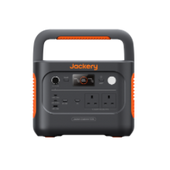
The Jackery Explorer 2000 v2 offers an integrated alternative to building a separate leisure battery and inverter system in a campervan or motorhome.

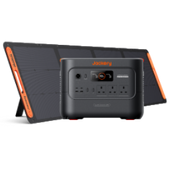
Its built-in GaN inverter provides 2,200W of continuous AC output, with a stated 4,400W surge capability, while the 2,042Wh LiFePO4 battery supplies the stored energy needed to run appliances away from electric hook-up.
The UK model includes two 230V AC sockets, one 18W USB-A port and two USB-C ports rated at 100W and 30W, allowing several devices to be powered or charged at the same time. The Explorer 2000 v2 is rated for 4,000 charge cycles, while the complete unit weighs approximately 38.6 lbs, making it portable enough to move between a motorhome, campsite and home without installing a permanent high-current inverter circuit.
Jackery Explorer 3000 v2
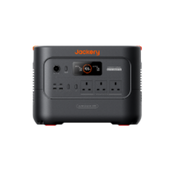
The Jackery Explorer 3000 v2 is designed for campervan and motorhome users who need more inverter power and stored energy than a typical mid-sized portable power station provides.

Its integrated pure sine wave inverter delivers 3,600W of continuous 230V AC output and up to 7,200W of surge power, while the 3,072Wh LiFePO4 battery provides the energy reserve for off-grid appliance use.
The UK version has three 230V, 13A AC sockets, two 100W USB-C ports, two 18W USB-A ports and a 12V car outlet, allowing refrigerators, laptops, lighting, device chargers and compatible cooking equipment to run from one unit. The battery is rated for up to 4,000 charge cycles, and Jackery specifies a 12-layer battery-management system, constant-voltage pure sine wave output and surge protection.
It is better suited to users who need to run items such as kettles, power tools or multiple pieces of equipment, while still observing the total output and surge limits.
|
Product |
Capacity |
Continuous AC output |
Better fit |
|
Jackery Explorer 2000 v2 |
2,042Wh |
2,200W |
Camping, work equipment and moderate backup |
|
Jackery Explorer 3000 v2 |
3,072Wh |
3,600W |
Larger appliances, longer runtime and multiple loads |
A portable power station is not automatically a replacement for a professionally wired campervan electrical system. Fixed sockets, shore-power integration or feeding vehicle circuits still require a designed installation.
How to Choose the Best 12V to 240V Inverter?
The best 12V to 240V inverter is not necessarily the model with the highest wattage. It should match the appliances, battery, cable route and installation type without creating unnecessary standby losses or excessive current demand.
Check the following before buying:
Choose pure sine wave for laptops, fridges, microwaves, medical equipment, variable-speed tools and appliances with electronic controls.
Match continuous output to real demand. Add the wattage of appliances that may run together.
Check the surge rating and duration. Motors, pumps, compressors and microwaves may need extra startup power.
Allow sensible headroom, but avoid selecting a much larger inverter than the system needs.
Review idle consumption. A large inverter can drain the battery even when the connected load is small.
Confirm battery chemistry and capacity. Lead-acid and lithium batteries have different usable-energy and discharge characteristics. Check the battery’s discharge-current limit. A lithium BMS may shut down even when the battery still has stored energy.
Use the specified DC cable size and fuse. High current makes undersized wiring a serious safety risk.
Look for low-voltage, overload and over-temperature shutdown. Confirm UK socket type, nominal 230V output and 50Hz frequency.
Check product safety markings, warranty support and UK instructions.
Consider installation location. The inverter needs ventilation and protection from moisture, fuel vapour and loose items.
Do not buy from headline wattage alone. A 3,000W inverter connected to an unsuitable battery and cable system is less useful—and less safe—than a correctly designed 1,000W setup.
FAQs
The following are the frequently asked questions about the 12V to 240V inverter:
1. Is it safe to use a 12V to 240V inverter?
Yes, when the inverter is correctly sized, fused, cabled and ventilated. The 230V output can cause fatal electric shock, while the 12V side can carry enough current to overheat cables or start a fire. Permanent vehicle installations should be designed and tested by someone competent.
2. How efficient is a 12V to 240V inverter?
Many quality pure sine wave inverters achieve roughly 85–95% efficiency, depending on load and operating conditions. Efficiency is usually lower at very small loads and some energy is also consumed while the inverter is idle.
3. What does a 12V to 240V inverter do?
It converts 12V direct current from a leisure battery into approximately 230V AC at 50Hz for UK plug-in appliances. It does not create energy; all output comes from the battery, with some lost as heat during conversion.
4. Will a 12V inverter boil a kettle?
Only if the inverter, battery, cables and fuse can support the kettle’s power demand. Many UK kettles use 2,000–3,000W, which can require more than 185–278A from a 12V battery after allowing for losses.
5. Can a 1,000W inverter run a kettle?
Usually not a standard UK kettle. Most draw well above 1,000W. A low-wattage travel kettle may work if its input rating and startup demand remain within the inverter’s continuous and surge limits.
6. How many amps does a 2,000W inverter draw from a 12V battery?
At 90% efficiency: 2,000W ÷ 12V ÷ 0.90 ≈ 185A
The actual current varies with battery voltage, inverter efficiency and appliance demand.
7. Can an inverter drain my car battery?
Yes. Even a small inverter can flatten a starter battery if used for long enough, and large loads can discharge it quickly. Starter batteries are designed for short bursts of engine-starting current, not repeated deep cycling. A separate leisure battery is normally preferable.
8. Can an inverter be installed under a bed?
Only if the manufacturer permits it and the space provides clear ventilation, secure mounting and protection from bedding, moisture and stored items. A sealed bed box is usually unsuitable because heat can build up and fabrics may block the fan.
9. Is a 24V inverter better than a 12V inverter?
For high-power systems, often yes. At the same wattage, a 24V system draws roughly half the current of a 12V system, reducing voltage drop and cable demand. A 12V system remains convenient for smaller loads and vehicles already built around 12V equipment.
10. Should you use 240V appliances or 12V appliances in a van?
Use 12V or USB appliances where suitable because they avoid inverter losses and often extend battery runtime. Choose 230V appliances when no practical DC alternative exists or when portability and normal household compatibility matter more than maximum efficiency.
Final Thoughts
The right inverter 12V to 240V is the smallest model that can support the required continuous load and startup surge without exceeding the battery, cable or fuse limits. Buying a larger inverter does not create more usable energy; it can increase standby losses and place heavier demands on the DC system.
For a permanent van conversion, calculate daily watt-hours, verify battery discharge capability and design the wiring as one complete installation. For camping, work equipment or temporary backup, an integrated power station may remove much of the component matching. Whatever route you choose, treat the 230V output as mains electricity and the 12V input as a high-current fire risk requiring suitable equipment and careful installation.


